
 Last week, we settled the question of the responsibility of all people when it comes to knowledge of God. Every human being living on planet earth has had the same revelation of God. It is the evidence of creation. If a person can look out at the created universe and fail to see the power and divinity of God, that person is knowingly and willfully refusing to see the truth -- not because they cannot see it, but because they are unrighteous and full of pride.
Today, we are going to look at God’s wrath and the reason why I deserve it, you deserve it, and every person on earth deserves it. Romans 1:18 says, “For the wrath of God is revealed from heaven against all ungodliness and unrighteousness…” and verse 21tells us why:“ For even though they knew God, they did not honor Him as God or give thanks, but they became futile in their speculations, and their foolish heart was darkened.”
Now stop for a moment and think of what it means to have a “darkened heart.” Are you thinking along the lines of hardened criminals? The men we see in the news – murderers, child molesters, rapists? Here’s the Bible’s portrayal of a darkened heart: “Professing to be wise, they became fools,” (rationalizing their sin, forming their own ideas about God and the world) “…and exchanged the glory of the incorruptible God for an image…” (idol worship. History is full of idolatry – even today, people you may know worship “nature” over God.) Are you thinking that these things really aren’t that extreme? Well, the darkened heart is only the first step. It’s at this point that God reveals His wrath.
How did God inflict His wrath? Romans 1:24: “God gave them up...” Verse 26: “God gave them up....” Verse 28: “God have them up....” Basically, God gave up!! He abandoned them. Read Romans 1:24-32. These verses describe the downward spiral of depravity in a person whom God has abandoned. Sure, some of the ramifications include murder and sexual sin. But the list also includes greed and envy. And strife (dissention), malice (spite), gossip (rumors), slander (insults), insolent (disrespect), arrogance (self-importance), boastful (proud), inventors of evil,
disobedience, without understanding, untrustworthy, unloving, unmerciful… Verse 32 says these things are worthy of death. I dare say, every person reading this is guilty. That said, I am - you are - we all are depraved. All mankind is depraved! And you may be uncomfortable and even provoked that I’d come right out and say it.
Consider the story of the modern day prodigal that came to the reading of his father’s Last Will and Testament. The young man stormed out of the lawyer’s office as the document was being read. See, the father began the Will by unfolding and recounting his son’s lifetime of bad behavior and wrongdoings. Being full of pride, this provoked and infuriated the son. So he walked out. Unfortunately, for the son, he missed the last paragraph of his father’s Will. See, the father had left his beloved son a very large estate and a few million dollars! The son failed to hear the whole story.
Yes, each of us is on that downward spiral of depravity unless and until we reach God’s grace and redemption. We need to hear and fully understand God’s plan of grace and redemption. We need to hear the whole “Will” of God for our lives. Please listen to all of what Romans will teach us.
Saturday, January 27, 2007
God Gave Them Up. . . to Depravity
-Pastor Mark


Tuesday, January 23, 2007
Rediscover God's Word. . .
 Discovering something for the first time is an experience of awe and wonder. The sheer adrenalin rush of a fresh encounter is almost addictive.
 But rediscovering something you have lost is an even deeper experience. In addition to the rush of awe and wonder, there is the deep sense of comfort and stability that lets us know that some things never change. They can be trusted.
God’s Word is like that. It can be trusted. The Bible reminds us that God cares about this world. He cares about us. Our lives may be entirely frenzied, but God’s Word is sustaining. It brings comfort and stability to chaos.
I invite you to Rediscover God’s Word here at Crane Chapel. I hope you are as excited as I am as we begin studying the Book of Romans together. Each time I dig into this portion of God’s Word, I am truly inspired! Romans is a masterpiece of truth. It outlines some of the greatest themes in the Bible: The Gospel of Truth, Grace, and Redemption.
The Book of Romans underscores that living a Christian life is so much more than doctrine. Romans is an essential roadmap for daily living. It has answers for all of our human dilemmas. Romans unfolds God’s plan for each of us to live a stable, fruitful, and joyful life. It can bring comfort and stability to our frenzied lives and our chaotic culture.
If you made any New Year’s Resolutions -- and you’re like the majority of Americans -- you’ve already broken them. Am I right? Resolve to make a new resolution: Rediscover God’s Word. And invite someone to join you.
- Pastor Mark E. Goossen
Without Excuse...

I remember the day my son Shepard was born. Dr. Strobel and I were standing there at my wife’s side passing time, hammering out and resolving a whole throng of theological issues. I do recall my wife interrupting a few times whining about something. (I’m sure her recall of that day is altogether different.) But little Shepard came! I’ll never forget that moment. I stood there, Dr. Strobel sang the Doxology, and what I wanted to do more than anything else was worship, just worship because I saw what God can do. I was Without Excuse.
You can argue about a lot of things, but you cannont argue about the birth of a child. Anybody who has ever witnessed the birth of a child knows there is a God. There is no other way. There is no other answer. There is nothing else you can say.
You can argue about a lot of things, but you cannont argue about the birth of a child. Anybody who has ever witnessed the birth of a child knows there is a God. There is no other way. There is no other answer. There is nothing else you can say.
Romans 1:20 says, “Since the creation of the world God’s invisible qualities – his eternal power and divine nature – have been clearly seen, being understood from what has been made, so that men are without excuse.”
So basically, the atheists in this world (and sadly, a lot of religious people too) are lying to themselves! That’s what Paul is saying here. Every single human being has witnessed God’s eternal power simply by existing on earth! God has put Himself on display. You don’t have to have much of a brain to understand that there is a God. Science can come up with and create many things, but it has yet to create something from nothing. A farmer can plant a seed, but he can’t make the seed grow. And how about an ocean tide? A sunset? Falling leaves? Migrating Geese? A Minnesota snow storm? These are the things that only God can do. By virtue of simply living on planet earth and having a conscience, we are Without Excuse!
Even those in far-off cultures who have never had an opportunity to hear the Gospel of Jesus Christ are Without Excuse. They too have received clear witness of the existence and character of GOD from nothing else but observing creation. They may be spiritually dead, but they are Without Excuse when it comes to understanding God’s power and nature. Here’s the key: A person needs to respond. If a person responds to God’s natural revelation, God will provide a means for that person to hear the Gospel. Remember the Ethiopian Eunich (Acts 8:26-39)? How about Cornelius (Acts 10:1-48). They were “good” men, but they were both spiritually lost…. until they responded.
So basically, the atheists in this world (and sadly, a lot of religious people too) are lying to themselves! That’s what Paul is saying here. Every single human being has witnessed God’s eternal power simply by existing on earth! God has put Himself on display. You don’t have to have much of a brain to understand that there is a God. Science can come up with and create many things, but it has yet to create something from nothing. A farmer can plant a seed, but he can’t make the seed grow. And how about an ocean tide? A sunset? Falling leaves? Migrating Geese? A Minnesota snow storm? These are the things that only God can do. By virtue of simply living on planet earth and having a conscience, we are Without Excuse!
Even those in far-off cultures who have never had an opportunity to hear the Gospel of Jesus Christ are Without Excuse. They too have received clear witness of the existence and character of GOD from nothing else but observing creation. They may be spiritually dead, but they are Without Excuse when it comes to understanding God’s power and nature. Here’s the key: A person needs to respond. If a person responds to God’s natural revelation, God will provide a means for that person to hear the Gospel. Remember the Ethiopian Eunich (Acts 8:26-39)? How about Cornelius (Acts 10:1-48). They were “good” men, but they were both spiritually lost…. until they responded.
And if we don’t respond? Romans 1:21 say, “For even though they knew God, they did not honor Him as God or give thanks, but they became futile in their thinking and their foolish heart was darkened.” There ya’ have it! Paul revealed the secret to the Romans and it’s ours for today: Reject the clearly identifiable light God gives – and it leads to greater darkness and depravity. Read the rest of Romans Chapter 1 to see exactly how. We really are Without Excuse.
-Pastor Mark
Monday, January 15, 2007
The Significance of the Book of Romans
 There is no book of the Bible which has been so instrumental in changing lives and in impacting the church as Paul’s Letter to the Romans. Most, if not all, of the great revivals and reformation in the history of the church have been directly related to the Book of Romans. I don’t often list a great deal of historical quotes and facts here. But as a pastor, my calling and my life’s goal is to see the Word of God change people’s lives. More than any other Biblical passage, Romans does that! Read on:
In 386 A.D., Aurelius Augustine received Jesus Christ as his Savior after reading a passage from the Book of Romans. He went on to become one of the church’s most outstanding leaders and theologians.
A thousand years later, Martin Luther wrote, “Night and day I pondered Romans until I grasped the truth. I felt myself to be reborn. This passage of Paul became to me a gateway to heaven.”
Several centuries later (May 24, 1738 to be precise), a minister named John Wesley wrote this about his study in the Book of Romans: “I felt my heart strangely warmed. I felt I did trust in Christ, Christ alone for my salvation; and an assurance was given me that He had taken away my sins….”
In assessing the importance of the Book of Romans, John Calvin said, “When one gains a knowledge of this Epistle, he has an entrance opened to him to all the most hidden treasures of Scripture.”
The famous sixteenth-century Bible translator William Tyndale wrote of Romans: “It is the principle and most excellent part of the New Testament... No man can read it too oft, or study it too well; for the more it is studied, the easier it is; the more it is chewed, the pleasanter it is. . . the more it is searched, the preciouser things are found….”
It has been said that Romans will delight the greatest logician and captivate the mind of the consummate genius, yet it will bring tears to the humblest soul and refreshment to the simplest mind. (Are you excited yet? I am!)
As a congregation, we’ve just come out of a wonderful study in the Book of Acts where we were introduced to the Apostle Paul. There is no dispute that Paul wrote the Book of Romans. Probably while in Corinth on his third missionary trip. His primary purpose in writing it was to teach the truth of Grace to new believers who had never really heard it. So Romans is primary a book of doctrine and contains little historical material -- but it does answer a lot of questions about man and God: What is the good news of God? Is Jesus really God? What is God like? How can God send people to hell? Why do men reject God and His Son? Why are there false religions and idols? What is man’s biggest sin? Why is there evil in the world? What is the standard by which God judges people? How can a person who has never heard about God be held spiritually responsible? Who is a true Jew? Can any person keep God’s laws perfectly? How can a person know he is a sinner? Where can people find real peace and hope? What exactly is grace? Why is living a Christian life such a struggle?
If you’ve ever asked questions like these, this sermon series from the Book of Romans is for you! Stay tuned. We’re just getting started!
- Pastor Mark
Wednesday, December 13, 2006
The Redemption Story Continues. . . Lessons from Noah's Ark...
 Ever listen to a three-year-old tell a Bible Story? The details are there, but the chronology is wide of the mark! A few days ago, I overheard my daughter Selah telling her brother about the shepherds and the baby Jesus sitting down to eat dinner with the disciples before they helped Zacchaeus climb down from a tree. Cute and amusing, huh? Well, I’m about to recount the story of Noah’s Ark and the Great Flood along with the birth of the Savior. No, Selah is not writing my sermons for me this month. There are many reasons why the story of Noah’s Ark is significant to the Advent of Christ and valuable in understanding the Why of Christmas. Let’s look…
First, Jesus told us that what characterized the times just before the flood will characterize the times just before His second coming: “As it was in the days of Noah, so it will be at the coming of the Son of Man.” (Matthew 24:37) So, what characterized the “days of Noah”? Scripture tells us it was a time when “men began to increase in number” (Genesis 6:1); and “the earth was corrupt” and “full of violence” (Genesis 6:11). Read a newspaper or watched the television news lately? Sounds current to me. The world needed a Savior in Noah’s day just as much as it did some 2000 years ago in Bethlehem and just as desperately as it does today. (Do you see the connection to the manger yet?)
Another reason that it is worthwhile to revisit the flood along with the Christmas story is that the Ark is an example of the judgment of God. (Yes, He is a God of judgment – not just grace and mercy and Christmas love.) In Genesis 7:16, we read that it was God who shut the door to the Ark. God had appointed a particular day of judgment. He had been longsuffering, waiting for many years. Sadly, only eight people were inside the Ark. You can almost hear the sound of the door banging shut against the side of the Ark. Perhaps the echo from that sound resounded in the ears of thousands (even millions) of people who looked on and mocked Noah. But as the door shut, judgment had arrived. Only those who had gone through the doorway could be saved. Fast forward now to II Peter 3:5-7 where Peter tells us that just as God sent a flood to destroy the earth because of the wickedness of man, one day there is going to be a final judgment. This time by fire. And God’s Word is clear: “If anyone’s name was not found written in the book of life, he was thrown into the lake of fire.” (Revelation 20:15) (Is the Why of the baby Jesus coming into focus?)
One last reason why the flood is almost a prerequisite lesson for the Nativity story is that Noah’s Ark is actually a picture of salvation. The Ark is representative of our salvation through Christ. God has provided an Ark of salvation for each of us. It’s the baby Jesus!! Jesus said, “I am the door: by me if any man enter in, he shall be saved.” (John 10:9) Just as Noah and his family had to go through a doorway to be saved, we need to go through a doorway – the Lord Jesus Christ. He is our ark of salvation.
… Now, why did Jesus come to earth as a tiny baby? He came to offer that Salvation to each one of us. The event of Noah’s Ark and the Great Flood is a sobering warning to each of us that we need to be saved too! And that’s the essence of Christmas: We can be!
- Pastor Mark
Monday, December 04, 2006
The Redemption Story. . . A Tale of Two Prototypes. . .
 Ever miss the first five minutes of a movie and remain pretty much clueless for the whole movie? I have. Well, the Christmas story is kind of like that. Only instead of a missed five minutes, many people have likely missed 4000 years! This Advent Season, we are looking at the Why of Christmas. Why did Jesus have to come to earth as a baby? To fully understand the unfolding Why of the Christmas story, we have to go back 4000 years to Genesis – to the very beginning.
Last week we stopped in Genesis 3 and looked at the story of the Fall of man where, in such pristine surroundings, our first parents exercised their volition to defy God’s one command. This blatant disobedience changed the world forever and loosed upon the world an avalanche of evil. But amidst the curse, God offered hope: He offered redemption. In Genesis 3:15, He proclaimed that the seed of the woman would crush the serpent. Satan would be bruised and hurt in conflict and ultimately receive a fatal blow. Adam and Eve are then expelled from the Garden of Eden and the story continues….
In Genesis Chapter 4 we come to the story of Cain, the first person ever born. (Adam, you remember, was created and Eve made from Adam.) Next we have Abel, the first sibling and the very first family. Then, sadly, we have the first family tragedy. Cain kills his brother Abel… And the Redemption Story is just beginning.
As we look at this passage in terms of that 4000-year preface to the baby Jesus story, Cain is the first non-believer. He is the prototype of the lost and doomed sinner. God always has clear purpose when He records for us stories in the text of Scripture. There are two kinds of people in the world: believers and non-believers. The account of Cain is given here in some detail in order that we might get a complete characterization of the typical unbeliever. From a general glance of the Chapter, we see that Cain harbored hatred in his heart and his actions were self-centered and godless. Cain had killed off the other possible prototype (the believer), so we’re left to wait for yet another offspring to embody the believer…
…and she called his name Seth: for God said she hath appointed me another seed instead of Able whom Cain slew. (Genesis 4:25) And here we have our believer. It’s through Seth’s progeny that we have a group of God-fearing people who will present the truth to a corrupt generation. And it is through Seth’s lineage that Jesus will be born 4000 years later.
The passage in Genesis rolls on almost like a movie until suddenly it stops and focuses on one man. That man is Enoch – the great, great, great grandson of Seth. Genesis 5:24 tells us that Enoch walked with God. Enoch was the very first prophet of the coming of Jesus: “And Enoch, the seventh from Adam, prophesied of these saying, ’Behold the Lord cometh with ten thousands of His saints to execute judgment upon all and to convince all that are ungodly among them of their ungodly deeds…’” (Jude 14)
And the question lingers. Which prototype are you? What are you doing in this godless generation? Are you self-centered/harboring hatred or are you walking with God?
- Pastor Mark
A Sweet Aroma. . . .

Who doesn’t love the smell of something wonderful baking in the oven? I know I do! The aroma of anything baking in the oven brings me from any part of our house to the kitchen with a yearning to taste what has produced that wonderful aroma. I don’t want to talk about the bread or the pie or the cookies. I want to eat the bread or the pie or the cookies! I want to enjoy it. It’s the way God made me.
I believe God’s activity in His people has the same effect upon our souls. When God’s people are about their Father’s business of living in His mercy, growing in His grace, sharing His love, and spreading His Word there is an aroma that fills the air. It wafts across a city, a county, a region, and even the world with a fragrance that draws people. They come with a yearning to taste and see what God is doing. They don’t want to simply talk about mercy, grace, love, and God’s Word. They want to enjoy it. They want to experience it. It’s the way God made us.
This past year, God has been baking in the kitchen called Crane Community Chapel and people are being drawn by the fragrance It’s a joyous thing for a pastor to see. It’s even more thrilling getting to personally know the people who have been drawn to Crane Chapel and learn that they’re not attracted by beautiful facilities or impressive programs or a certain style of music. What I see are new Christians and newcomers who are drawn by a spiritual hunger that is only met by the discipleship of fellow-Christians and solid Biblical teaching. As a pastor,
this is my burden and my ministry: To preach the Word of God as faithfully as it is written and to see that new Christians are discipled. It is a joy to watch the incorruptible seed take root and come to fruition. Seeing people hungry for the Word of God is a thrill!
To each of you who’ve had a part in bringing new believers to Christ in 2006 and for discipling them in the Word: Thank You! To each of you who’ve shown His mercy, grace and love throughout this past year in ways only seen by Christ Himself: Thank You!
God is definitely at work among us. There is a wonderful aroma coming from the kitchen of Crane Chape. The meal is prepared. The table is set. Invite a guest so we can Spread the Good News of Jesus Christ! That’s the purpose of the Church and that’s the meaning behind Christmas!
I believe God’s activity in His people has the same effect upon our souls. When God’s people are about their Father’s business of living in His mercy, growing in His grace, sharing His love, and spreading His Word there is an aroma that fills the air. It wafts across a city, a county, a region, and even the world with a fragrance that draws people. They come with a yearning to taste and see what God is doing. They don’t want to simply talk about mercy, grace, love, and God’s Word. They want to enjoy it. They want to experience it. It’s the way God made us.
This past year, God has been baking in the kitchen called Crane Community Chapel and people are being drawn by the fragrance It’s a joyous thing for a pastor to see. It’s even more thrilling getting to personally know the people who have been drawn to Crane Chapel and learn that they’re not attracted by beautiful facilities or impressive programs or a certain style of music. What I see are new Christians and newcomers who are drawn by a spiritual hunger that is only met by the discipleship of fellow-Christians and solid Biblical teaching. As a pastor,
this is my burden and my ministry: To preach the Word of God as faithfully as it is written and to see that new Christians are discipled. It is a joy to watch the incorruptible seed take root and come to fruition. Seeing people hungry for the Word of God is a thrill!
To each of you who’ve had a part in bringing new believers to Christ in 2006 and for discipling them in the Word: Thank You! To each of you who’ve shown His mercy, grace and love throughout this past year in ways only seen by Christ Himself: Thank You!
God is definitely at work among us. There is a wonderful aroma coming from the kitchen of Crane Chape. The meal is prepared. The table is set. Invite a guest so we can Spread the Good News of Jesus Christ! That’s the purpose of the Church and that’s the meaning behind Christmas!
- Pastor Mark Goossen
Monday, November 27, 2006
The Why of Christmas. . .
 Much of the beauty of Christmas is found in its sameness. The same traditions. The same food. The same hymns. The same biblical account of the Baby Jesus in Bethlehem with shepherds and angels. Yet each Christmas is a little different. Sometimes that difference is dramatic. Sometimes it is subtle – delicate and quite and kept in our hearts to reflect on in times of peaceful silence.
This Christmas, I invite you to look at Christmas from a new vantage point. We’re all another year older and, hopefully, wiser and more mature in God’s Word. This year I want you to look past the story set in Bethlehem. Past the idea of the baby in a manger to the reason that God came to earth as that infant boy. Sure it was to ultimately suffer a grotesque yet passionate death on a rugged cross, but beyond that… Why did He have to die? Where did it all begin? I invite you to start at the beginning. Yes. The beginning. The Book of Genesis.
Genesis 3 is our point of origin. It is arguably the most important chapter in the entire Bible because it explains why the rest of the Bible was written. The entire Bible tells the story of redemption -- of salvation -- of deliverance from sin. Genesis 3 explains why the world needs this redemption.
It is impossible – and ridiculous to even try -- to understand the world. We’ve got people trying and supposedly coming up with solutions; but it is in fact impossible for humans to understand the cosmos, the ordered world of creation. It is impossible to understand the disintegration of matter. It is impossible to understand the collapsing world and universe and it is impossible to understand man’s behavior if you do not understand that everything that exists in the world today is a product of sin and that that sin is a result of what happened in the Garden of Eden.
The impact of the Adam and Eve’s sin – man’s fall -- has touched every part of the universe. It is accurate to say that absolutely everything wrong in our world is because of sin. When God made things he said, “…it was good.” (Genesis 1:31) But because of sin everything is very bad: from world wars, terrorism, mass murders, serial killings, plane crashes, auto accidents, fires, crippling and maiming of people because of accidents, nuclear reactor disasters, radiation poisoning pollution, cancer, heart disease, all illnesses, broken relationships, divorce, orphaned children, drugs, crime, dereliction in all forms, confusion, conflict, struggle, disappointments, anxiety, fear, guilt, depression, sorrow, failure, remorse, lust, selfishness, pride, hatred, covetousness, rebellion, murder, stealing, sexual immorality., irresponsibility, disobedience to parents and authority and gossip.
Now…why did Jesus come as a precious infant boy? Sure, it was to die on a cross. But why did He have to die?
- Pastor Mark
Monday, November 20, 2006
The Beginning of the End...
 One of the most operative words in today’s society is "interactive." We’ve got interactive books and videos and computer software and educational curricula that permit us to interact with an issue or topic by adding our own ideas and answers and endings. It’s just part of our postmodern world; the kind of thing that would make our grandparents smirk. But as we look at the way Luke concludes the Book of Acts, he is showing us in very much the same way that we are to interact fully with its message. Luke wants us to continue the story…
 Last week we left the shipwreck survivors on the island of Malta where tradition says they stayed from mid-November till about mid-February. Then Paul and the rest of the assengers and crew put out to sea again (Acts 28:11). Verse 14 reads, “…we came to Rome. Continuing, we find out that some Christians in Rome had heard that Paul was coming, greeted him and provided a reception and escort fit for an emperor. What an irony: Paul
the imperial prisoner makes a triumphal procession to the capital of the Empire! …Paul thanked God and was encouraged (Acts 28:15). Why? From our study of Acts we know that one of Paul's long-standing desires was to bear witness in Rome. Well, he finally got there – in chains, through shipwreck, and with significant obstacles behind him – and once there, he preached! As Luke concludes the Book, he reminds us again that Christians were denounced everywhere by the Romans. He tells again how Paul persisted in using the Law of Moses to teach the Jews that Jesus was indeed Messiah. Some were convinced by what he said, but others would not believe.” (Acts 28:24) Read Paul’s response in Acts 28:28 and then read Acts 13:46. And with that account, Luke's story is pretty much over.
Luke’s literary artistry had certainly come full circle. Paul’s entrance into Rome is just the beginning of the fulfillment of Acts 1:8 -- that the Gospel would be proclaimed to the ends of the earth. Why does Luke end the Book of Acts so abruptly? The book is not so much about the life of Paul, but about the spread of the gospel. Now that the gospel had been established and preached in Rome - the world’s center of trade and government - it would definitely spread to the ends of the earth. It simply wasn’t necessary to write anything else about the continuing history of the Church. We are the Church. We are writing its history today. We are interacting with the message! Look at Luke’s final words in Acts 28:30-31: “For two whole years Paul…welcomed all who came to see him. Boldly and unhindered he preached the Kingdom of God and taught about the Lord Jesus Christ.”
Despite all the obstacles and the Roman government's attitude toward Christianity, Paul was unhindered. This message (the part where we are supposed to start interacting) is framed by one of Luke’s very last words: akolytos, “unhindered.” Paul was unhindered in his witness. It’s no different today. We’ve got obstacles. We’ve got a government that is more-or-less indifferent (often hostile) toward Christianity. Despite our postmodern world, things are still pretty much the same. But, as Christians, we’re called to be bold and unhindered as we interact with and continue the story. Where are you in this interactive story?
– Pastor Mark
Sunday, November 12, 2006
The Shipwrecks of Life. . .

Have you ever been so immersed in a storyline that you just had to see it to its conclusion? I hope today’s message is every bit as good as the last great television plot you followed. It is after all the conclusion to a great series. If television producers created TV programs based on New Testament history, the depiction of the Apostle Paul’s shipwreck would make a great reality series.
Here’s a thumbnail sketch of the story. Paul has been in prison for two years in Caesarea. He has appealed his case to Caesar so he is sent to Rome by ship. The final two chapters of Acts describe this journey. Everything seems to have gone wrong for Paul in these last two chapters. As a missionary, he couldn’t do too much preaching as a prisoner; and the journey to Rome was an utter catastrophe. Let’s look as Luke’s vivid chronicle of the journey:
“…the winds were against us. (27:4) We made slow headway for many days. . . (27:7) Much time had been lost and sailing had become dangerous…(27:9) A wind of hurricane force called the northeaster swept down from the island. The ship was caught by the storm and could not head into the wind. (27:14-15) We took such a violent battering from the storm that the next day they began to throw cargo overboard. (27:18) The soldiers planned to kill the prisoners, so that none would swim away and escape; but the centurion commanded that those who could swim should jump overboard and get to land.” (27:42-43)
There’s an old saying that man’s extremity is God’s opportunity. We, too, have shipwrecks in our lives – our careers, marriages, families, and hopes. So do those around us. We can draw enormous help and comfort from this story, because Paul demonstrates a God-honoring and practical way to respond to our own shipwrecks and the trials of those around us.
Paul was perfectly aware of the calamity around him, yet there is a quiet confidence, even joy, in his words and actions. Paul told the crew, “I urge you to keep up your courage, because not one of you will be lost; only the ship will be destroyed.” (27:22) And we read in verse 36 that “they were all encouraged.” Paul provided HOPE.
Up to this point, we’ve seen Paul’s leadership as an evangelist and a missionary. And while a shipwreck is not exactly the right time for evangelistic services, Paul looks for every opportunity to talk about his faith in God. When he ate food, he “gave thanks to God in front of them all.” (27:35) And in announcing that there would be a shipwreck, he explains, “I have faith in God that it will happen just as He told me.” (27:25) In the shipwrecks of life we, like Paul, can provide APPROPRIATE WITNESS.
During these nightmarish fourteen days, it’s very likely that most of the passengers were desperately seasick. Paul told them, “I urge you to take some food. You need it to survive.” Paul provided PRACTICAL ADVICE.
The lesson for us? Paul combined spirituality with sanity. Faith with works. He was a man of God and of action. A man of the Spirit and of common sense. We cannot avoid the shipwrecks of life. What we can do is use our circumstances to glorify God. We can stay the course and develop character. We can rest in God’s promises!
Here’s a thumbnail sketch of the story. Paul has been in prison for two years in Caesarea. He has appealed his case to Caesar so he is sent to Rome by ship. The final two chapters of Acts describe this journey. Everything seems to have gone wrong for Paul in these last two chapters. As a missionary, he couldn’t do too much preaching as a prisoner; and the journey to Rome was an utter catastrophe. Let’s look as Luke’s vivid chronicle of the journey:
“…the winds were against us. (27:4) We made slow headway for many days. . . (27:7) Much time had been lost and sailing had become dangerous…(27:9) A wind of hurricane force called the northeaster swept down from the island. The ship was caught by the storm and could not head into the wind. (27:14-15) We took such a violent battering from the storm that the next day they began to throw cargo overboard. (27:18) The soldiers planned to kill the prisoners, so that none would swim away and escape; but the centurion commanded that those who could swim should jump overboard and get to land.” (27:42-43)
There’s an old saying that man’s extremity is God’s opportunity. We, too, have shipwrecks in our lives – our careers, marriages, families, and hopes. So do those around us. We can draw enormous help and comfort from this story, because Paul demonstrates a God-honoring and practical way to respond to our own shipwrecks and the trials of those around us.
Paul was perfectly aware of the calamity around him, yet there is a quiet confidence, even joy, in his words and actions. Paul told the crew, “I urge you to keep up your courage, because not one of you will be lost; only the ship will be destroyed.” (27:22) And we read in verse 36 that “they were all encouraged.” Paul provided HOPE.
Up to this point, we’ve seen Paul’s leadership as an evangelist and a missionary. And while a shipwreck is not exactly the right time for evangelistic services, Paul looks for every opportunity to talk about his faith in God. When he ate food, he “gave thanks to God in front of them all.” (27:35) And in announcing that there would be a shipwreck, he explains, “I have faith in God that it will happen just as He told me.” (27:25) In the shipwrecks of life we, like Paul, can provide APPROPRIATE WITNESS.
During these nightmarish fourteen days, it’s very likely that most of the passengers were desperately seasick. Paul told them, “I urge you to take some food. You need it to survive.” Paul provided PRACTICAL ADVICE.
The lesson for us? Paul combined spirituality with sanity. Faith with works. He was a man of God and of action. A man of the Spirit and of common sense. We cannot avoid the shipwrecks of life. What we can do is use our circumstances to glorify God. We can stay the course and develop character. We can rest in God’s promises!
- Pastor Mark
Wednesday, November 01, 2006
The Search For Church...

It's a simple childhood game taught by Sunday School teachers. It was an “interactive learning experience” before anyone had ever spoken that phrase. Standing before the class, a teacher would ask children to fold their hands together, interlocking their fingers. “Here’s the church,” she would say as two- and three-year olds looked curiously at their folded hands. Then, pointing the forefinger of each hand skyward, she would say, “Here’s the steeple.” Children would giggle as their pudgy fingers formed the shape of a spire pointing to the heavens. There would be a moment of anticipation as the teacher turned her folded hands toward the class and nodded toward her thumbs, which now formed the shape of a door underneath the finger steeples, and said, “Open the doors,” while turning her hands just the right way to make the previously hidden fingers visible, “and see all the people!” Across the room there’d be gasps of pre-school amazement and gleeful giggles.
I am always thrilled to see children learn the Biblical truth that the church is the people of God and not a building or a social agency or an historical institution or a even a babysitter! I’m even more thrilled when adults grasp it. I mean really grasp it. Sure, people make up the church, but people also make up the Chamber of Commerce and the Boy Scouts. The Church is a living, breathing, divine body made up of people who have surrendered their lives to Jesus – its head! Sadly for some, finding the Church can be a life long search.
Over the last few months, we’ve been on a journey through the Book of Acts. We’ve uncovered the beginnings of the New Testament Church and walked in the footsteps of the first missionary. We’ve discovered this living organism known as the Body of Christ. Unfortunately there are countless people living among us who still haven’t experienced church as the Body of Christ! They still only understand it as a New Testament narrative. As a pastor, I observe it every Sunday morning. I catch sight of it in the community everyday: People who have never been able to see and experience what the Body of Christ is really designed to be. As a result, some believe the church is irrelevant. Others decide to attend other churches that will, obviously, be better than what they have experienced in the past and will better fit their current needs. Others resign themselves to a spiritual stagnation and become content with the empty ritual of simply “attending” church instead of experiencing a vibrant relationship with God and His Family. And God is grieved.
Over the last (almost) eighteen months we’ve been on another kind of journey. A journey known in church circles as a “building phase.” We’ve been planning and constructing and waiting. And waiting. And the search for our church building is almost over! Drive near the 1100 block of Ninth Street NE and our new church building is instantly recognizable! Within weeks we’ll watch as that much-anticipated steeple rises into the sky and fine-tunes the skyline of Austin. I’ll probably be there. With a camera! See, as I’ve driven through Austin over the last few weeks, I’ve wondered to myself, “Will the steeple be visible from here? How about here? At what point on Interstate-90 will I see it? ” Have you done that too? Don’t get me wrong. I am just as excited as anyone else about our new building. It’s very important to have an attractive and functional building. People are far more likely these days to attend church in a nice building. Outward appearance is important. But . . . News flash! The church is not the building! Do I sound like a broken record? Good. If our new building defines Crane Community Chapel for you, perhaps you haven’t fully grasped that childhood game.
. . . Are you searching for Church?
- Pastor Mark
God's Will vs. Bad Counsel
Beginning in Acts 21, we come to the “home stretch” of the Book of Acts. It’s here that Paul enters Jerusalem against the advice of many fellow believers, including his traveling companions. He is falsely accused, nearly killed, and then arrested (and thereby rescued) by Roman authorities. Sounds like quite a plot for a movie! But this isn’t Hollywood. No. We’re dealing here with the greatest missionary of all time, thus it was an occasion for Paul to -- once again -- proclaim the Gospel!
Paul had resolved to go on to Jerusalem while he was still in Ephesus, and along the way he met and fellowshipped with fellow believers. One would imagine these meetings to be very similar to what took place in Miletus. As they departed each city, they knelt together and prayed and said tender and tearful goodbyes. We’re also told in Acts 21:4 that “they repeatedly told Paul through the Spirit not to set foot in Jerusalem.” But Paul pressed on, rejecting the warnings, convinced that his suffering was the will of God. He is not only willing to suffer, but also to die for Christ. I don’t know about you, but I read this account with great admiration for Paul. I am amazed to find that some godly scholars have reached the conclusion that Paul was wrong, in his decision to continue on the Jerusalem.
Nowhere in Scripture are we told that Paul did wrong. The remaining chapters of Acts do not indict Paul for wrongdoing; they honor him for his faithfulness! And Paul’s words to Timothy strongly imply that he had not departed from God’s will, but that he had fulfilled it:
Paul had resolved to go on to Jerusalem while he was still in Ephesus, and along the way he met and fellowshipped with fellow believers. One would imagine these meetings to be very similar to what took place in Miletus. As they departed each city, they knelt together and prayed and said tender and tearful goodbyes. We’re also told in Acts 21:4 that “they repeatedly told Paul through the Spirit not to set foot in Jerusalem.” But Paul pressed on, rejecting the warnings, convinced that his suffering was the will of God. He is not only willing to suffer, but also to die for Christ. I don’t know about you, but I read this account with great admiration for Paul. I am amazed to find that some godly scholars have reached the conclusion that Paul was wrong, in his decision to continue on the Jerusalem.
Nowhere in Scripture are we told that Paul did wrong. The remaining chapters of Acts do not indict Paul for wrongdoing; they honor him for his faithfulness! And Paul’s words to Timothy strongly imply that he had not departed from God’s will, but that he had fulfilled it:
I have fought a good fight, I have finished my course, I have kept the faith:
… there is laid up for me a crown of righteousness, which the Lord, the righteous Judge, will give me at that day… II Timothy 4:7-8
Here’s the scene once Paul arrives in Jerusalem: He’s falsely accused of a high Jewish crime, resulting in a riot in which he is nearly put to death on the spot. He’s placed under arrest. He shares his testimony with the some Jews. This results in another riot. In Chapter 23, we find Paul standing before the Sanhedrin. Realizing that there will be no justice here, Paul identifies himself as Pharisee, thus resulting in even more tumult. Paul is then confined to the military barracks for his own protection until they can decide what to do with him. (Talk about conspiracy!?) That night, Jesus Himself stands beside Paul and speaks:
Be of good cheer, Paul: for as thou hast testified of me in Jerusalem, so must thou bear witness also at Rome. –Acts 23:11
These are not words of rebuke. These are words of commendation. Paul, like Jesus before him, set out toward Jerusalem, knowing full well the turmoil awaiting him. (Compare Luke 9:51 and Acts 19:21.) So why does Luke record all the warnings from other well-meaning believers? Well, Scripture is full of advice on not taking advice from evil people. Luke’s account might just be telling us that bad counsel can come from those who deeply love us too. Our most intimate and trusted friends might be giving bad advice. Are you close enough to Christ – are you mature enough in your faith - to discern God’s will from bad counsel? Read Paul’s words in II Corinthians 1:3-6 and 4:17-18 before you answer.
- Pastor Mark
Monday, October 23, 2006
The Heart of Christian Work...
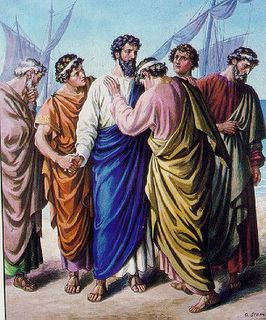
One of the most exciting things in ministry is allowing God’s Word to speak over the current and dramatic moments in the life of a church. Our study of the early Church in the Book of Acts parallels our own church building project and that’s exciting because God’s Word really has been coaching us on the real mission of the Church body. (By now, I do hope you know the difference between the two.) Up until now, Luke has been narrating the work of the early Church along with the journeys and ministry of the Apostle Paul. But in Acts Chapter 20, Luke takes a twist and invites us into the heart of Paul the Missionary. It’s an especially poignant and tender passage. It speaks directly to those in ministry even though it applies to all of us. It speaks to the heart of anyone involved in Christian work.
Here’s the situation of the passage. The final dramatic events of Acts are about to happen with the Apostle Paul’s arrest in Jerusalem and his eventual appearance before Caesar in Rome. But on his way to Jerusalem, Paul spends some time with the leaders of the church at Ephesus. He sends for the elders and they meet just outside of Ephesus in a town called Miletus. Here Paul has some final words for them. He knows he will not see them again until they meet in heaven.
Here’s the situation of the passage. The final dramatic events of Acts are about to happen with the Apostle Paul’s arrest in Jerusalem and his eventual appearance before Caesar in Rome. But on his way to Jerusalem, Paul spends some time with the leaders of the church at Ephesus. He sends for the elders and they meet just outside of Ephesus in a town called Miletus. Here Paul has some final words for them. He knows he will not see them again until they meet in heaven.
“You know how I lived the whole time I was with you, form the first day I came into the province of Asia. I served the Lord with great humility and with tears, although I was severely tested by the plots of the Jews. You know that I have not hesitated to preach anything that would be helpful to you but have taught you publicly and from house to house. I have declared to both Jews and Greeks that they must turn to God in
repentance and have faith in our Lord Jesus.” - Acts 20:18-21
These verses are Paul’s summation of his life and ministry in Ephesus. What strikes me here is that Paul was a man sold out for Jesus and driven by a burden for people. His words clearly map-out for us the heart of Christian work and the necessary priorities. Look at the passage again. First: Paul served the Lord… no matter what! And he did it with humility and tears. Second: He did not hesitate to preach anything that would be helpful because building up the Church and reaching the unsaved was indeed the essence of his work. Paul’s needs and desires aren’t even mentioned. They of course came last in the arrangement of priorities. Quite a contrast from the “wisdom” of our day. We’re overrun with views and ideas and guidance on how to take care of “self.” Visit any bookstore and you’ll find an entire section called “Self Help.” Try to find a Bible in the same store. Not quite as big a section for God’s Word. That’s sad.
Back to my opening words: As a pastor it is both amazing and humbling to allow God’s Word to speak over the current and dramatic moments in the life of a church. In a few weeks, we will be in a brand new church building and the Celebration of Christ’s Birth will be upon us. Many will be occupied with details. Don’t let those details cast a shadow on the heart of your work as a Christian. Keep His Word – The Bible - your priority.
-Pastor Mark
Thursday, October 12, 2006
The Power of the Gospel...

Last week I told you that I believe there are people in Austin yet to be saved. There is work to be done in Mower County, and Crane Chapel has the mission, the people, and the resources to do it! Need some encouragement? In Acts 19, Luke gives a fascinating account of how the Gospel of Christ reached and affected an entire city and its surrounding area through a relatively small group of Christians. That city was Ephesus.
Ephesus was a luxurious city, but it was given up to the occult and black magic. The people cooked up mysterious formulas to give them wealth and happiness and success. Superstition, sorcery, and the worship of idols were very common. The Ephesians worshipped the Asiatic goddess Diana (or Artemis), the goddess of fertility. Their supreme glory was the temple of Diana, one of the Seven Wonders of the World. And a principal business of Ephesus was the making of small idols and shrines. Ephesus, like Corinth, was saturated with idolatry, witchcraft, riots and immorality. Enter: The Apostle Paul. (Doesn’t it seem as though Paul is somehow drawn to these kinds of cities?)
Paul stayed and preached in Ephesus for over two years. And Christianity became one of the most powerful influences in the city. Ephesus also became one of the most famous churches in the world. The Gospel so affected the city that its economy was actually disrupted! Remember: the production of idols and shrines was a major business here.
What was Paul’s secret? It is no secret. It is the power of the Gospel of Jesus Christ. It has the power to overcome Satan and all those things he uses to destroy us (witchcraft, etc.). Later in his letter to the church in Ephesus Paul would write, “For we are not fighting against people made of flesh and blood, but against the evil rulers and authorities of the unseen world, and against wicked spirits in the heavenly realms.” (Eph. 6:12) And in his letter to the Corinthians he said, “We use God’s mighty weapons, not mere worldly weapons, to knock down the Devil’s strongholds. With these weapons we break down every proud argument that keeps people from knowing God. With these weapons we conquer their rebellious ideas and we teach them to obey Christ.” (II Cor. 10:4-5)
Ephesus was a luxurious city, but it was given up to the occult and black magic. The people cooked up mysterious formulas to give them wealth and happiness and success. Superstition, sorcery, and the worship of idols were very common. The Ephesians worshipped the Asiatic goddess Diana (or Artemis), the goddess of fertility. Their supreme glory was the temple of Diana, one of the Seven Wonders of the World. And a principal business of Ephesus was the making of small idols and shrines. Ephesus, like Corinth, was saturated with idolatry, witchcraft, riots and immorality. Enter: The Apostle Paul. (Doesn’t it seem as though Paul is somehow drawn to these kinds of cities?)
Paul stayed and preached in Ephesus for over two years. And Christianity became one of the most powerful influences in the city. Ephesus also became one of the most famous churches in the world. The Gospel so affected the city that its economy was actually disrupted! Remember: the production of idols and shrines was a major business here.
What was Paul’s secret? It is no secret. It is the power of the Gospel of Jesus Christ. It has the power to overcome Satan and all those things he uses to destroy us (witchcraft, etc.). Later in his letter to the church in Ephesus Paul would write, “For we are not fighting against people made of flesh and blood, but against the evil rulers and authorities of the unseen world, and against wicked spirits in the heavenly realms.” (Eph. 6:12) And in his letter to the Corinthians he said, “We use God’s mighty weapons, not mere worldly weapons, to knock down the Devil’s strongholds. With these weapons we break down every proud argument that keeps people from knowing God. With these weapons we conquer their rebellious ideas and we teach them to obey Christ.” (II Cor. 10:4-5)
These passages remind us that we have an enemy. He isn’t our boss, or our spouse, but a spiritual enemy. The Bible clearly teaches that Satan is a manipulator. Scripture describes him as the “god of this world.” Until Paul’s arrival, Satan held Ephesus in bondage. The people lived in confusion and they indulged themselves in lust and desire and magic. We have our own form of magic today: The magic of money, or power, or possessions or human capability dominate the culture. But we are called to battle the stronghold. How? Several weeks ago, I challenged you to ask God to bring to your mind someone to share the Gospel with. Some of you have shared that you’ve taken up this challenge. As a reminder: This is why the Church exits – to rescue people out of Satan’s bondage. And believe me, Ephesus isn’t that much different from our culture today. The Power is in the Gospel of Jesus Christ. Share it!
– Pastor Mark
Friday, October 06, 2006
Salvation in the Midst of Depravity...

What's the mood…the atmosphere…the character of our beloved Southeastern Minnesota? You know what I mean: When folks from New York City visit, with what impressions do they leave? And how does a native of Southern California feel after a stopover in Brownsdale or Taopi? Well, I’ve lived in California and I’ve lived in rural Minnesota. Believe me. They’re two entirely different mission fields!
I think the Apostle Paul went through a much greater sort of culture shock when he left Athens and headed to Corinth. Athens was the intellectual capital of the Roman world. It’s where they had that entire amphitheater called Areopagus set aside just for intellectual and philosophical debate. Now Corinth is a beautiful city located about fifty miles west of Athens. It’s situated on a narrow neck of land between the Adriatic Sea and the Aegean Sea. And there was a great temple on Acrocorinth (the hill behind the city). Sounds magnificent, right? Here’s the not-so-magnificent part: Every evening a thousand-some priestesses would come down into the city streets to carry out their trade, indulging in lasciviousness, immorality, and depravity. The city of Corinth had the reputation throughout the whole Roman world as the center of sensuality.
Remember how troubled and offended Paul was over the worship of idols in Athens? Imagine his distress over the open depravity in the streets of Corinth? This was a definitely a low point in Paul’s life and ministry. He was alone on this trip. He longed for the companionship of Silas and Timothy. He was short on finances and had to enter the workforce as a tentmaker working with leather. He was becoming more and more aware of Jewish opposition to the Gospel. And he had just left Greece – an area he felt was an unproductive area for the message of Christ. Remember too that Paul grew up in a very religious and strict Jewish home. So he had to have been quite appalled and disturbed over the evil perversion running rampant in the streets of his newest mission field.
But let’s look at the text of Acts 18:9-10: “Then the Lord spoke to Paul in the night by a vision, ‘Do not be afraid, but speak and do not keep silent; for I am with you, and no one will attack you to hurt you; for I have many people in this city.’” Know what? Paul stayed another eighteen months! And if you know your New Testament Books, you know that the two longest Pauline Epistles were written to the people of this depraved city of Corinth. People were actually saved in Corinth.
Is there a lesson in this for us? Of course. The Gospel of Jesus Christ is the same no matter where you go and to whom you speak. Californians need the Gospel of Salvation no more and no less that us Midwesterners. Never predict the outcome of your witness (intentional or unintentional). Just go ahead and share it!
I think the Apostle Paul went through a much greater sort of culture shock when he left Athens and headed to Corinth. Athens was the intellectual capital of the Roman world. It’s where they had that entire amphitheater called Areopagus set aside just for intellectual and philosophical debate. Now Corinth is a beautiful city located about fifty miles west of Athens. It’s situated on a narrow neck of land between the Adriatic Sea and the Aegean Sea. And there was a great temple on Acrocorinth (the hill behind the city). Sounds magnificent, right? Here’s the not-so-magnificent part: Every evening a thousand-some priestesses would come down into the city streets to carry out their trade, indulging in lasciviousness, immorality, and depravity. The city of Corinth had the reputation throughout the whole Roman world as the center of sensuality.
Remember how troubled and offended Paul was over the worship of idols in Athens? Imagine his distress over the open depravity in the streets of Corinth? This was a definitely a low point in Paul’s life and ministry. He was alone on this trip. He longed for the companionship of Silas and Timothy. He was short on finances and had to enter the workforce as a tentmaker working with leather. He was becoming more and more aware of Jewish opposition to the Gospel. And he had just left Greece – an area he felt was an unproductive area for the message of Christ. Remember too that Paul grew up in a very religious and strict Jewish home. So he had to have been quite appalled and disturbed over the evil perversion running rampant in the streets of his newest mission field.
But let’s look at the text of Acts 18:9-10: “Then the Lord spoke to Paul in the night by a vision, ‘Do not be afraid, but speak and do not keep silent; for I am with you, and no one will attack you to hurt you; for I have many people in this city.’” Know what? Paul stayed another eighteen months! And if you know your New Testament Books, you know that the two longest Pauline Epistles were written to the people of this depraved city of Corinth. People were actually saved in Corinth.
Is there a lesson in this for us? Of course. The Gospel of Jesus Christ is the same no matter where you go and to whom you speak. Californians need the Gospel of Salvation no more and no less that us Midwesterners. Never predict the outcome of your witness (intentional or unintentional). Just go ahead and share it!
- Pastor Mark
Wednesday, October 04, 2006
Help Me to Live for Others...
“Others”
By C.D. Meigs
Lord help me live from day to day
In such a self-forgetful way
That even when I kneel to pray
My prayer shall be for – Others.
Help me in all the work I do
To ever be sincere and true
And know that all I do for you
Must needs be done for – Others.
Let “Self” be crucified and slain
And buried deep; and all in vain
May efforts be to rise again
Unless to live for – Others.
And when my work on earth is done
And my new work in heaven’s begun
May I forget the crown I’ve won
While thinking still of – Others.
Others, Lord, yes others
Let this my motto be
Help me to live for others
That I may live like Thee.
F rom the very first phases of our building project, we have make every effort to not overlook the vision and mission of Crane Community Chapel. And a recent visit by Della and Dave Matt reaffirmed that vision. On Sunday, October 1st, Della shared a beautiful poem entitled Others.
As we continue studying and understanding the birth of the New Testament Church in the Book of Acts, let’s continue to understand and appreciate how very important Crane Chapel’s heritage of serving others really is.
It was to serve others that Christ came down from His glory to clothe himself in human flesh. It was for others that He gave His life on a cross. It was service to others that drove the missionaries in the Book of Acts to distant cities and far-away lands to share the life-giving message that Jesus saves.
Yes. . . Others must be our passion and it must be the purpose for the very existence of Crane Chapel. Whether others be a toddler, an AWANA child, a teen, a single adult, a busy mom, a working man, a widow, a senior citizen, or a shut-it, we must be available for service to others.
"Others, Lord, yes others; Let this my motto be."
- Pastor Mark Goossen
Laughed Off The Hill...
It doesn’t take too many clicks of your television remote, or even a trip through a grocery store checkout aisle to be convinced that we live in a time of “spiritual” exploration. In many respects, not unlike that of the pagan world of Greece when Paul preached in Athens. It was here that Paul became quite candid and outspoken over the worship of idols. It was the custom then, in Athens, for the philosophers of the time to gather at an arena near Areopagus – or Mars Hill -- for debate over philosophies and ideas. Acts 17:21 records Luke’s observations: “Now all the Athenians and the strangers visiting there used to spend their time in nothing other than telling or hearing something new.” The Greeks would like to have us think that they were seeking truth through their debate, but very much like today, “spirituality” was to great extent nothing more that a consumer item. A fad. Like Americans, the Greeks had a great attraction to novelty.
In that regard Paul found himself in a situation very much unlike any today. Rather than the message of Jesus being rejected because it was something people thought they had already heard, the Gospel was exciting to the Greeks because it was something “new.” Isn’t it interesting that Christianity is rejected so frequently in today’s society because people think they already know everything about it -- when in reality they don't have a clue? Well, in Paul's case, the Gospel was heard! The people of Athens recognized that this “philosophy” was something new and fresh. Something they did not know. But, oddly, Paul spoke to them as if they did in fact already know it. Paul stood in the midst of the Areopagus and said, “I perceive that in all things you are very religious; for as I was passing through and considering the objects of your worship, I found an altar with this inscription: ‘TO THE UNKNOWN GOD.’ Therefore, the One whom you worship without knowing, Him I proclaim to you.” (Acts 17:22-23)
Paul began by directing their thoughts "to the unknown god" by speaking of the God the Creator: “God, who made the world and everything in it, seeing He is Lord of heaven and earth, does not dwell in temples made with hands. Nor is He worshipped with men’s hands, as though He needed anything, seeing He gives to all life, breath, and all things.” Well, the philosophers – being pagan philosophers – rejected it. They laughed Paul off Mars Hill. They especially didn’t buy the whole resurrection part!
Throughout history, peoples of all cultures and all religious beliefs have known something of God in the wonders of creation. They know God the Creator through his works and the sense of awe of His Creation. Paul wrote in Romans 1:19-20, “…what may be known of God is manifest in man for God has shown it to them for since the creation of the world His invisible attributes are clearly seen being understood by the things that are made even His eternal power in Godhead so that they are without excuse.”(Romans 1:19-20) Sad part is, like the philosophers at Areopagus, people are still rejecting Him and laughing. What do you think? Is He the unknown God? “He was in the world, and the world came into being through Him; yet the world did not knowHim.” (John 1:10)
In that regard Paul found himself in a situation very much unlike any today. Rather than the message of Jesus being rejected because it was something people thought they had already heard, the Gospel was exciting to the Greeks because it was something “new.” Isn’t it interesting that Christianity is rejected so frequently in today’s society because people think they already know everything about it -- when in reality they don't have a clue? Well, in Paul's case, the Gospel was heard! The people of Athens recognized that this “philosophy” was something new and fresh. Something they did not know. But, oddly, Paul spoke to them as if they did in fact already know it. Paul stood in the midst of the Areopagus and said, “I perceive that in all things you are very religious; for as I was passing through and considering the objects of your worship, I found an altar with this inscription: ‘TO THE UNKNOWN GOD.’ Therefore, the One whom you worship without knowing, Him I proclaim to you.” (Acts 17:22-23)
Paul began by directing their thoughts "to the unknown god" by speaking of the God the Creator: “God, who made the world and everything in it, seeing He is Lord of heaven and earth, does not dwell in temples made with hands. Nor is He worshipped with men’s hands, as though He needed anything, seeing He gives to all life, breath, and all things.” Well, the philosophers – being pagan philosophers – rejected it. They laughed Paul off Mars Hill. They especially didn’t buy the whole resurrection part!
Throughout history, peoples of all cultures and all religious beliefs have known something of God in the wonders of creation. They know God the Creator through his works and the sense of awe of His Creation. Paul wrote in Romans 1:19-20, “…what may be known of God is manifest in man for God has shown it to them for since the creation of the world His invisible attributes are clearly seen being understood by the things that are made even His eternal power in Godhead so that they are without excuse.”(Romans 1:19-20) Sad part is, like the philosophers at Areopagus, people are still rejecting Him and laughing. What do you think? Is He the unknown God? “He was in the world, and the world came into being through Him; yet the world did not knowHim.” (John 1:10)
- Pastor Mark
An Unusual Place for a Hymn Sing...
One thing pastors (and missionaries) learn fairly quickly is that ministry is not a nine-to-five job. That’s because the Gospel of Jesus Christ works twenty-four hours a day. Life happens twenty-four hours a day and people are touched and converted in very unusual circumstances. Sometimes we might avoid speaking about Christ because we just don’t think the circumstances suggest a favorable outcome. And we just might be making the wrong choice when we think that way.
Consider one such set of unfavorable circumstances: The time isn’t right. It’s midnight. The place isn’t right. The believers are in a dungeon-like prison, they’re physically wounded, and restrained in stocks. And the potential convert is a heartless, heathen jailer. (Sunday School recollection should be kicking in here…) The believers are of course Paul and his co-worker Silas. It’s Paul’s Second Missionary Journey and he had traveled to the city of Philippi in Macedonia to preach. Interestingly, this is the very first time that the Gospel of Christ is being proclaimed on the European mainland.
In Acts 16:14-15 we meet the first convert – a business woman named Lydia. She and all of her family believed and were baptized. Paul and Silas continued on preaching, and a servant girl who was controlled by an evil spirit began to follow them. Everywhere they preached, this girl would yell and cry out. She was shouting out truth, but it was so disruptive. See Paul was a very well-thought-out speaker. He was reasoned and logical. He really wanted people to understand and think about what he was saying. That was hard with all the disruptive yelling. So the evil was cast out of this girl. And everyone was happy. Well almost everyone…
“But when her masters saw that the hope of their gains was gone, they caught Paul and Silas and dragged them into the marketplace before the authorities.” (Acts 16:19) The girl had been used by her masters to “tell fortunes” and so forth. People figured she had a “gift” and paid money for it. Paul and Silas were accused of throwing the community into confusion and they were severely beaten and thrown into prison.
In prison…in stocks…bruised and bleeding…and surrounded by criminals. What does one do? Pray and sing hymns, of course! Well, that’s not the usual thing to do, but these are not your usual prisoners. We all know what happened next….Sunday School recall! Earthquake…jailer wants to kill himself…and in the end the jailer washes the wounds of Paul and Silas and he and all his family believed and were baptized. (Read Acts 16:30-31)
Imagine the impact of the things said in prayer and hymns on the jailer and the other prisoners. It was a far cry from the threats and curses usually heard in such places. The message had its effect on the listeners. It always does. The gospel has the power to save souls, and we have the responsibility to teach it. The Gospel can work effectively in all kinds of circumstances. What are you doing with the Gospel?
- Pastor Mark
Friday, September 08, 2006
Snapshots From an Extraordinary Journey...

Admittedly, family vacation snapshots are not standard fare for a church newsletter. Family photos just don’t mean much to anyone except the family members captured in them. But these snapshots might just be the exception to any such rule. See, our family’s ordinary journey to Indiana and Kentucky in August brought us face to face (literally) with Crane Chapel’s exciting future and it’s esteemed past. After attending a week of classes at FLAME (Fellowship of Leaders Acquiring Ministerial Education) in Frankfort, Indiana, we headed to Zionsville, Indiana to visit Joe and Della Matt along with Dave and Nancy. The Matts really do have a deep love for Crane Chapel and Crane Chapel has a rare appreciation, understanding and respect for the Matt Family. The Matts aren’t just former pastors. The Matts are Crane Chapel’s heritage. The Matt Family has truly influenced generations. And these particular family photos are priceless.
In much the same way, the snapshots of the early Church we’ve been uncovering in the Book of Acts are priceless and designed to instruct and influence generations of Christians. As Christians, these snapshots are our heritage. The Apostle Paul’s Extraordinary Missionary Journeys are no exception; and this is where we’re going next in our Building the Church Series. Paul’s first missionary journey starts in Acts Chapter 13, where we see the first powerful expansion of the Church. Acts 13:49 records, “…the Word of the Lord was being preached throughout the whole region.”
The Apostle Paul’s Missionary Journeys are not just a piece of New Testament history. Paul’s experiences are precious family snapshots. They are reminders that the same things experienced by Paul and his companions will happen wherever and whenever the Gospel is preached.
Our study over the next weeks should spur us to reexamine our own conclusions about what the church is and should be doing. The Church in 2006 – indeed Crane Chapel itself -- retains its legitimacy only in as much as it presents a continuum of the Early Church. The Church in Acts was not stagnant or self-serving. It was not a church gripped with too many details and social concerns. Paul told Timothy: “Preach the Word!” (II Timothy 4:2) This is what Church is all about. Too many modern churches have usurped Christ’s position as head of the Church and have allowed “the way we’ve always done it” or “this is what the community needs” to dictate the future. Let’s allow this study of Paul’s Journeys to really focus the true mission of the Church. These snapshots really are the framework for the Church for every generation.
In much the same way, the snapshots of the early Church we’ve been uncovering in the Book of Acts are priceless and designed to instruct and influence generations of Christians. As Christians, these snapshots are our heritage. The Apostle Paul’s Extraordinary Missionary Journeys are no exception; and this is where we’re going next in our Building the Church Series. Paul’s first missionary journey starts in Acts Chapter 13, where we see the first powerful expansion of the Church. Acts 13:49 records, “…the Word of the Lord was being preached throughout the whole region.”
The Apostle Paul’s Missionary Journeys are not just a piece of New Testament history. Paul’s experiences are precious family snapshots. They are reminders that the same things experienced by Paul and his companions will happen wherever and whenever the Gospel is preached.
Our study over the next weeks should spur us to reexamine our own conclusions about what the church is and should be doing. The Church in 2006 – indeed Crane Chapel itself -- retains its legitimacy only in as much as it presents a continuum of the Early Church. The Church in Acts was not stagnant or self-serving. It was not a church gripped with too many details and social concerns. Paul told Timothy: “Preach the Word!” (II Timothy 4:2) This is what Church is all about. Too many modern churches have usurped Christ’s position as head of the Church and have allowed “the way we’ve always done it” or “this is what the community needs” to dictate the future. Let’s allow this study of Paul’s Journeys to really focus the true mission of the Church. These snapshots really are the framework for the Church for every generation.
- Pastor Mark Goossen
The Great Debate Over Grace. . .
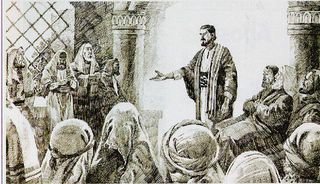
Crane Chapel is a very busy church. We have a lot of meetings! We’ve got AWANA Meetings, Trustee Meetings, Church Board of Administrators Meetings, Youth Worker Meetings, WMS Meetings, Planning Meetings, Worship Committee Meetings (the list goes on…). Well, Acts Chapter 15 describes the most important meeting of the Early Church. And the issue at hand is one that affects all of us today -- regardless of which meeting(s) you attend or don’t attend here at Crane Chapel. The future of the entire Church was at stake in Acts 15: Was it to remain a sect of Judaism, or would it allow uncircumcised Gentiles? Remember Christ said: “Go therefore and make disciples of all the nations…” (Matt. 28:19) Let's look deeper at the controversy and how the Council of Jerusalem was formed.
“Some men came down from Judea and began teaching the brethren, `Unless you are circumcised, according to the custom of Moses, you cannot be saved.' " (Acts15:1) They were saying that circumcision was required for salvation. They probably figured: Christians should obey God and God commanded circumcision. Paul and Barnabas had a very different opinion: "And Paul and Barnabas had great dissension and debate with them…”(Acts 15:2). How was the argument to be resolved? In the interest of unity within the Church, Paul and Barnabas were appointed, along with some other believers, to go to Jerusalem to see the apostles and elders over the controversy. And like most controversial meetings, it had a name: The Jerusalem Council.
Among the Council was Peter. (Remember good-old outspoken Peter?!) In the first of three speeches at the council, Peter began to scold those who wanted the Gentiles to obey the laws of Moses. His words amounted to one of the strongest defenses of salvation by grace alone contained in all of Scripture: “…why do you put God to the test by placing upon the neck of the disciples a yoke which neither our fathers nor we have been able to bear? But we believe that we are saved through the grace of the Lord Jesus, in the same way as they also are.” (Acts 15:10-11). This verse is the crux of the entire matter! Peter's point is that the “yoke” of Moses’ various laws were a burden that the Jewish people were – frankly -- unable to keep. No matter how hard people worked to keep those rituals, they could never be perfect. They showed that works can never lead to salvation. Salvation is attained in a different way. By grace. Grace alone. We cannot earn it. It must be given to us. Paul wrote in Ephesians 2:8, “For by grace you have been saved through faith; and that not of yourselves, it is the gift of God; not as a result of works, so that no one may boast.”
Are you trusting in God’s Gift of Grace or your own “works?”
“Some men came down from Judea and began teaching the brethren, `Unless you are circumcised, according to the custom of Moses, you cannot be saved.' " (Acts15:1) They were saying that circumcision was required for salvation. They probably figured: Christians should obey God and God commanded circumcision. Paul and Barnabas had a very different opinion: "And Paul and Barnabas had great dissension and debate with them…”(Acts 15:2). How was the argument to be resolved? In the interest of unity within the Church, Paul and Barnabas were appointed, along with some other believers, to go to Jerusalem to see the apostles and elders over the controversy. And like most controversial meetings, it had a name: The Jerusalem Council.
Among the Council was Peter. (Remember good-old outspoken Peter?!) In the first of three speeches at the council, Peter began to scold those who wanted the Gentiles to obey the laws of Moses. His words amounted to one of the strongest defenses of salvation by grace alone contained in all of Scripture: “…why do you put God to the test by placing upon the neck of the disciples a yoke which neither our fathers nor we have been able to bear? But we believe that we are saved through the grace of the Lord Jesus, in the same way as they also are.” (Acts 15:10-11). This verse is the crux of the entire matter! Peter's point is that the “yoke” of Moses’ various laws were a burden that the Jewish people were – frankly -- unable to keep. No matter how hard people worked to keep those rituals, they could never be perfect. They showed that works can never lead to salvation. Salvation is attained in a different way. By grace. Grace alone. We cannot earn it. It must be given to us. Paul wrote in Ephesians 2:8, “For by grace you have been saved through faith; and that not of yourselves, it is the gift of God; not as a result of works, so that no one may boast.”
Are you trusting in God’s Gift of Grace or your own “works?”
- Pastor Mark
Subscribe to:
Posts (Atom)


