Thursday, July 13, 2006

Encounters With Civil Authorities

Then Peter and the other apostles answered and said,
“We ought to obey God rather than men.” - Acts 5:29


Peter and the apostles are in jail again being reprimanded by the Sanhedrin: “We gave you strict orders not to teach in Jesus name, didn’t we? Yet you have filled Jerusalem with your teaching and are determined to bring this man’s blood on us!” And of course, the apostles respond with civil disobedience by very straightforwardly announcing that they would obey God – not man!

The Sanhedrin neither liked nor did they welcome the apostles in Jerusalem because the reception of the Gospel by the multitudes was toppling their spiritual leadership. If the people had ignored the apostles’ preaching, the Sanhedrin would not have cared what the apostles did. But clearly the people were excited over the miracles and receptive to the message of Life in Jesus. Peter had become so popular among the people that the arresting officers were actually afraid to touch him. Now put yourself in Peter’s sandals and try to imagine a similar scenario today. Would civil disobedience be the “right thing to do?” What would you do?

Those who call themselves Christians today can harm the testimony of true Christianity by the way they behave toward civil authorities. Believers are to set their affections and priorities on Christ, and His Word, but they are also to be godly and obedient citizens in society. Sometimes it’s a fine line. Peter tells us (in I Peter 2:13) “Submit yourselves for the Lord’s sake to every human institution.” He was commanding believers to respect civil authority. And in I Timothy 2:1-3, Paul instructs us to pray “for all that are in authority; that we may lead a quiet and peaceable life.” Quite a contrast from Peter’s defiance toward the Sanhedrin. Where do you draw the line?

First, we need to acknowledge that God is in control of all situations and that He has ordained civil authority. (Romans13:1-7) So when a Christian submits to civil authority, he/she is obeying God. When civil authorities say, (for example) “We’re raising the Minnesota sale tax to 21.5% to fund highway maintenance,” and this does not violate the teaching of God’s Word, we should obey with meekness and without speaking evil of anyone. (Titus 3:1-3) It is sad when those who name Christ defy the very government He ordained. His Kingdom just does not benefit from disobedience. Even if we disagree!

The one exception is if civil authorities tell us to do something that would violate God’s Word. In Acts 4:18 the Sanhedrin commanded Peter and John “not to speak or teach at all in the name of Jesus.” We know that Jesus told us in Matthew 28:19-20 that we have authority to teach and make disciples of all men.” And we know what happened to Peter. As Christians we must stand for Christ and His Word and be willing to suffer the consequences. But we must be careful not to go beyond the teaching of God’s Word. The early church did submit itself to the extremely pagan Roman government, realizing that God had ordained it. What about you? Are you willingly submitting to our God ordained government?
– Pastor Mark
(21.5% sales tax?! See Romans 13:6-7.)

Encounters With Sadducees

Christians nowadays have it pretty easy. Not often will sharing the Gospel of Jesus send us to jail as it did Peter and John. Still we run risks in trying to win others to Christ. And while most of us might be willing to spend a night in jail if it would bring 5,000 people to Christ, shouldn’t we also be willing to suffer for the sake of one?

In Acts Chapter 4, Peter and John were sharing the Gospel of Jesus when – as scripture records – “The priests and the captain of the temple guard and the Sadducees came up to [them.]” What we need to understand about this group is that they were members of a powerful Jewish sect that did not believe in the resurrection of the dead. They stood to gain financially by cooperating with the Romans; and it was they who engineered and carried out Jesus’ arrest and crucifixion. The Sadducees had almost unlimited power over the temple and thus they were able to arrest Peter and John for no other reason than teaching something that contradicted their beliefs. And they did!

Now Peter and John stood before the same council that had condemned Jesus to death. Peter and John were questioned and this whole incident is considered the first persecution of the Church. But. . . instead of being defendants, the apostles were on the offensive: boldly speaking out for God and presenting the Gospel. In Acts 4:12 we find the final thrust of Peter’s defense speech. As Peter stood before these powerful, sophisticated, cultured, wealthy rulers of the Jewish people, the Holy Spirit gave him these words: "Salvation is found in no one else, for there is no other name under heaven given to men by which we must be saved."

Now, the Sadducees – along with many “Sadducees” of today -- reacted negatively to the fact that there is no other name than that of Jesus to call on for salvation. They say, "That’s too extreme. We believe in diversity and in accepting all “spiritual paths.” Surely Jesus isn’t going to send Indians, Chinese, Tibetans, and so on, to hell because they don’t believe in Jesus!"

Well, you may go ahead and call me a narrow-minded, extremist preacher! I will not apologize for preaching that there are only two paths: the broad way, which goes to hell, and the narrow way, which leads to eternal life with Jesus. You may accuse me of believing in this absolute truth that Jesus is the only Savior of the world. I do not mind because Peter’s statement is absolutely true: "There is no other name under heaven by which we must be saved." Peter did not decide this. The Church did not decide this. It is the specific teaching of Jesus himself (John 14:6).

As believers, we will encounter Sadducees. Perhaps you are a Sadducee – unwilling to accept that only Jesus saves. Be assured, Jesus alone saves! Not Jesus and Mary, nor Mary and the saints, nor our baptism as a child, nor “good works.” Whether we believe it or not, Jesus alone saves, and his purposes shall be accomplished! Are you willing to put yourself on the line for the gospel as did Peter and John? Are you willing to stand up to the Sadducees? Are you willing to stand up for Jesus when those around you start talking about “diversity” and accepting all “spiritual paths?”
- Pastor Mark

Thursday, June 15, 2006

The NFL, Barnabas & Father's Day


Joseph, a Levite from Cyprus, whom the apostles called Barnabas - which means Son of Encouragement – sold a field he owned and brought the money and put it at the apostles’ feet.”

- Acts 4:36


I
read about a University football coach who each year would privately talk to a new player at the beginning of football season. He told him, “I’m very impressed with your ability. If you work really hard this year, I think you’re good enough to make it to the National Football League.” He told this to every player on the team! You know what happened? He had the highest percentage of players of any University to make it into the NFL.

We’ve all met people like that who believed in us so much that we began to believe in ourselves. The result was we tried harder and we did better. The Book of Acts introduces us to an early disciple who was that way.

We first meet Barnabas in Acts 4:36. He was a Levite from the Island of Cyprus and apparently had some wealth. The disciples called him “Son of Encouragement.” And his name definitely matched his character.

After the Apostle Paul’s conversion on the Road to Damascus, Barnabas came along side Paul when no one else would. (Acts 9:26-27). Why? Barnabas was a very kind-hearted, gentle, and easy-going person. He had great compassion. And we will discover that Paul - unlike Barnabas - was a very stubborn man. Paul was used greatly by God but he was a very strong-willed man. Barnabas overlooked Paul’s rough character and they made an effective ministry team.

When the church in Antioch began to grow, Acts 11:22 tells us that Apostles is Jerusalem sent Barnabas there to help out the new church. Why? “He was a good man, full of the Holy Ghost and faith; and a great number of people were brought to the Lord.” (Acts 11:24)

In Acts 15:39 we read about Barnabas and a young minister named John Mark. Barnabas was willing to work patiently with John Mark when Paul - in harshness and haste - saw no hope for the young man. Do you see a pattern in the life of Barnabas?

We need more Barnabas’s in the church today. For that matter, we need more Barnabas-like fathers in the world: Fathers who are good and full of the Holy Ghost and faith. Fathers who will overlook character flaws and demonstrate compassion. Fathers who will see the potential in the younger generation and encourage it.
If you’re a father, you’re probably going to get an “interesting” gift today. Your children may do something that really makes you feel like a king. Soak it all it, because you deserve it and it’s good for your children to honor you. But honor them too by letting some of Barnabas rub off on you. Be a “Son of Encouragement.”

-Pastor Mark

Witness to a Miracle


One day at three o'clock in the afternoon, Peter and John were on their their way into the Temple for prayer meeting. At the same time, there was a man crippled from birth being carried up. Every day he was set down at the Temple gate, the one named Beautiful, to beg from those going into the Temple. When he saw Peter and John about to enter the Temple, he asked for a handout. Peter, with John at his side, looked him straight in the eye and said, "Look here." He looked up, expecting to get something from them. Peter said, "I don't have a nickel to my name, but what I do have, I give you: In the name of Jesus Christ of Nazareth, walk!" He grabbed him by the right hand and pulled him up. In an instant his feet and ankles became firm. He jumped to his feet and walked. The man went into the Temple with them, walking back and forth, dancing and praising God. Everybody there saw him walking around and praising God. They recognized him as the one who sat begging at the Temple's Gate Beautiful and rubbed their eyes, astonished, scarcely believing what they were seeing.


- Acts 3:1-10 (MSG)

Imagine now that you are in the above passage. It’s a Sunday morning and you’re making your way from your car toward the front doors of the Labor Center. You do a double take because you see Peter and John walking ahead of you. You’ve heard so much about them and now here they are coming to Crane Chapel! You wonder what they are talking about...what they look like in person…what kind of personality each has. You reach those double glass doors and you see a man who is disheveled and crippled – probably homeless - stretched out in that little alcove and he’s calling out to everyone passing by. Everyone knows about this guy. He’s a nuisance -always begging for money. You’re uncomfortable and embarrassed. The anticipation of what will happen next grabs your throat. You see the crippled man reach out to touch Peter and John! Others have walked by and acted as if the crippled guy was invisible. What next?!

It’s a clear beautiful warm day and the sun is shining as if spotlighting the whole thing: Peter and John stop and reach down tenderly to the man. Peter speaks to him and offers his hand. The man takes Peter’s hand and looks intently into Peter’s eyes. You feel a strong sense of the Holy Spirit here and you watch in awe – with everyone else around you – as the man gets up off the ground, stands with help from Peter, becomes tall and straight, and starts walking! You can’t believe your eyes! You’ve never seen anything like this before and in an instant you realize that Jesus– through Peter- has touched the man with healing and grace and mercy! You’re numb. You make your way into the building in silent wonderment and take a seat. And there’s the crippled “nuisance” guy beaming, joyful, and totally healed! What are you thinking?

Now, think about what those who witnessed the experience at Gate Beautiful in Acts Chapter 3 were thinking. This was actually the very first miracle of the new Church in Acts. We read in Chapter 4 that five thousand people were added to the Church. Do you think those witnesses just went home and thought about it? …Had they, would those five thousand have been added?

- Pastor Mark

Friday, June 02, 2006

They Devoted Themselves...


“They devoted themselves to the apostles’ teaching and to the fellowship, to the breaking of bread and to prayer.” - Acts 2:42


When you’re in the midst of a large project, every now and then you stand back and take a breath and look around. Sometimes in awe. If you missed the last few days at our building site you missed some awe. The foundation of Crane Chapel’s new church building is now standing - quickly erected over a period of just days! Milestones like this are good landing-places for us to consider again the mission of God’s Church.

In the Book of Acts, there are a number of such landing-places where Luke suspends the course of his narrative, in order to give us a general idea of the condition of the Church at the moment. Acts 2:42 is such a resting-place.

We’ve already seen how the early Church got its start with an encounter with the living God on the day of Pentecost. Luke records that thousands were brought to faith in Christ that day and were added to the Church. But their faith not only changed their destiny. It changed the way they lived!

What you believe affects what you do. This was certainly true of the first Christians. The text says that they devoted themselves. They devoted themselves first to the apostles’ teaching. In other words, they gave a high priority to understanding the Truth. Now that they had come to know Jesus, they wanted to know more about Him. They wanted to understand how to apply this teaching to their lives. Are you devoted to teaching?

The second thing they devoted themselves to was the fellowship. It is interesting how many people think that they really don’t need the fellowship of other believers. Not so for the early Church. They saw the need to continually devote themselves to a shared life with other believers. You can only experience true fellowship by giving diligent attention to meeting together with other believers. Are you devoted to fellowship?

Thirdly, they devoted themselves to the breaking of bread. Now this could mean one of two things – but probably both. It could mean that they shared their meals together. But it most likely meant that they devoted themselves to the ordinance of the Lord’s Supper. We observe this today.

Finally, Luke tells us that they devoted themselves to prayer. Their focus was heavenward, toward God Himself. They gave themselves to a life of prayer. … And so we see that God’s Church is a church in which people exhibit a deep level of commitment – a devotion to the disciplines of teaching, fellowship, breaking bread, and prayer. Let’s remember that. Our new building is only a physical structure – a place where we meet to express, share, and affirm our commitment to Christ.

– Pastor Mark

Thursday, June 01, 2006

Building Foundations


The first and foremost part of any building project, after receiving the blueprint, is the layout and installation of the foundation. All the tools and equipment and manpower are of no use until the foundation work is properly laid. And regardless of the efforts put into the construction of the foundation, the integrity of the foundation will be adversely affected by improper soil conditions. Those involved in Crane Chapel’s building project are very aware of these details. Bottom line: buildings need a well-thought-out, firm foundation and even the dirt has to be in good condition.

But let’s step back from Crane Chapel’s building project and consider another type of foundation. June is traditionally a month of weddings and wedding anniversaries and it’s a good time to reflect on the foundation of marriage. Much like the foundation for a building, marriage is the supporting building block of … well, human civilization! Read Genesis Chapter Two. After He created the universe, the first thing God instituted was marriage! God’s entire plan for human relationships begins with marriage. When we dismiss God’s plan for marriage, we undermine it altogether and society suffers.

Tragically, this is exactly what has happened over the last few decades. For the first time in its history, Western civilization is confronted with the need to define the meaning of the terms “marriage” and “family.” The loss of a true biblical understanding of marriage and family has led to a complete breakdown of the institution -- even among Christians.

Marriage is now easily severed by divorce. And even within traditional Christian marriages, couples refuse to acknowledge and accept their God-ordained roles and responsibilities. When marriage fails, the whole family falls apart; when the family fails, the whole society suffers. And every day the headlines are filled with society’s suffering. It may seem like an oversimplification of things, but the breakdown of marriage is a huge part of what’s going wrong in our world today.

So what kind of foundation makes a marriage work? In a word: God. God is the architect. He designed the blueprint for marriage and His Word addresses an entire spectrum of issues related to marriage and family. Issues from gender roles to human sexuality, reproduction, parenthood, and more. God’s design is that marriages are characterized by companionship, support, love, affection, full communication, understanding and mutual respect. Husbands and wives must fully realize that marriage is a life-long commitment regardless of wealth or poverty, health or sickness, or “irreconcilable differences.” Scripturally speaking there is only one (yes, one!) valid reason for divorce. So there’s the foundation: God’s Word.

Sadly, too many marriages have gone ahead and built on flawed foundations. They’ve ignored God’s blueprint or they’ve compromised it by selecting only the sections they like. And for a while (and in some cases many years) these marriages are maintained and they appear healthy. But over time, evidence of foundation failure manifests itself. The exterior structure deteriorates and a lot of time and effort are spent cosmetically repairing things rather than correcting the foundation. And what about the soil? (Crane Chapel’s building project was actually delayed because our soil samples exposed bad dirt!) What’s the condition of each spouse’s personal relationship with God? That’s the soil test of marriage! That’s where you have to start.

Ecclesiastes 4:12 says, “A cord of three stands is not quickly broken.” The rope-makes of the ancient world discovered that a rope made of a single or even a double stand of thread could be broken very easily; however, a rope made of thee stands was not so easily broken. The verse is not so much about ropes as it is about marriage. A person by him or herself, without companionship, support and love is like a cord of one stand. They are not very strong. Two people who support and love each other, like a rope of two stands, is stronger. A three-stand cord, however, is even stronger. In marriage a thee-stand cord is husband and wife and God. This sort of marriage is not easily broken.

There is no way to build a solid marriage without God. There is no way to sustain a marriage outside of His instructions. And while a solid marriage is built more quickly when both husband and wife accept and practice a Scriptural foundation for marriage, God expects each of us to respond to him regardless of the circumstances of our family. When only one spouse is committed to God, the union can still be blessed! The best part is that God allows and encourages us to turn from our past and begin following Him today.

How many cords are there in your marriage? What’s the condition of your foundation? How about the soil?

- Pastor Mark Goossen

Friday, May 26, 2006

The Birth of the Church


“For John truly baptized with water;
but ye shall be baptized with the Holy Ghost…”
- Acts 1:5

What thoughts come to mind when you hear the phrase “Baptism of the Holy Spirit?” How about the word “Pentecost?” A lot of Christians get nervous when the topic is addressed. The whole issue of “speaking in tongues” is raised and it scares people. The uneasiness is most likely born out of a misunderstanding of the actual events in Acts Chapter Two. In actuality, the passage very plainly and quite straightforwardly narrates the Birth of the Church.

(By the way, Pentecost is simply the Greek name for the Jewish Festival known as “Feast of Weeks.” Translated, the word means “fiftieth” and the festival came exactly fifty days after Jesus’ resurrection. And we’ll get to the “tongues” part…)

Acts Chapter Two is one of the greatest transitions recorded in Scripture. Up to now, the Spirit was with God's people, but from now on, He would indwell them and then fill them. In Chapter One, Jesus prepares the way for the birth of the church, and in Chapter Two it's born! In Chapter One, the disciples wait for the Holy Spirit, and in Chapter Two He comes! In Chapter One they are equipped by Christ, and in Chapter Two they are empowered by the Spirit. Basically, Chapter Two satisfies Chapter One. Acts 1:8-9 says, "Ye shall receive power after the Holy Spirit is come…” And after He had spoken these things, He was taken up…. Christ’s presence was in a physical form during His ministry on earth. And when He left this earth, His presence – and ministry -- remained alive and visible by the indwelling and continual filling of His Spirit.

Acts Chapter Two records the first appearance of the Spirit which we know today as the indwelling. It was a one-time, permanent gift for all believers. But the Chapter also narrates a filling of the Spirit. It’s the filling of the Spirit that caused the disciples to run into the streets in joy. And it’s the filling that enables His work to be done in churches today. One commentator put it this way: “The pressure of His presence caused an eruption of joy! …The filling is thrilling. Anyone obsessed with the joy of Jesus is filled with the Spirit.” (C.S. Lovett)

As for the whole “tongues” issue – There were no “holy rollers” among the disciples at Pentecost. No. Nobody was praying quietly in a corner in some secret “prayer language.” No. The room was full of uncontainable excitement! Soon the noise was heard in the streets. People stopped to listen. And remember, Jerusalem was full of foreigners because of the Jewish Feast of Pentecost. It was then that the Spirit provided the gift of (known) languages and dialects to those filled with His Spirit. The Spirit had commenced His work - encouraging and facilitating the spreading of the Good News! Isn’t God’s wisdom and timing amazing! The Birth of the Church fell on a Jewish holiday and foreigners who had never heard of Jesus suddenly were hearing the Good News! . . . The Church really does work best and accomplish Christ’s purpose when it is filled with His Spirit.


- Pastor Mark

Friday, May 19, 2006

I Will Build My Church


The world’s view of the church today is anything but complimentary. Sure, Crane Community Chapel had some praiseworthy reports four weeks ago. Our groundbreaking ceremony was a top news-story on April 23rd. The event made each of the three local television stations and several regional newspapers and the stories were positive. But what about today? What words does the average non-churched person use to describe churchgoers? Here’s some I’ve heard (and remember, I used to work in a factory): hypocrites, religious fanatics, judgmental, out-of-touch, dull, lifeless, weird. The sad part is, most of these descriptions are true! Churches are guilty of these things. Why? Because many of us have forgotten what the Church really is!

Today, we begin a study of the Book of Acts. As we move through this study, we’re going to become eyewitnesses to the birth and growth of the Church – the way Jesus intended it. My hope is that we will recognize that the Church is not just a “body of believers,” but a body of believers with a very important mission.

The Book of Acts is the very essential sequel to Jesus’ ministry on earth. It’s very easy for us to think of the Resurrection Story as the END of His ministry. How wrong we’d be! Jesus’ life up to this point was just the foundation! I Corinthians 3:11 tells us that “…no man can lay a foundation other than the one which is laid, which is Jesus Christ.” Jesus could have elected to build His church some other way, but He chose instead to work THROUGH people. Specifically: His disciples. See, the work of the Church could not be done while Jesus was still in physical human form. The disciples were to operate in the flesh, while Jesus operated in the Spirit. The disciples were to effectively take His place on earth. And today – two thousand years later – it’s our job to take His place and carry on the building of His Church. We are going to understand through our study exactly what that means and exactly how we are to do it. And it has nothing to do with constructing a new building. A year from now, we will most likely worship in a brand new church facility. But our work as the Church will still be ongoing! The physical construction of a church building is short-lived. The mission of the Church is eternal!

Bible teacher Ray Stedman has called the Church the “secret government of the earth” because it “radically alters the status quo wherever it is found.” Interesting. The Apostle Paul says that the Church is “…the pillar and the ground of the truth.” (I Timothy 3:15) And Jesus said: “…upon this Rock I will build My Church; and the gates of hell shall not prevail against it.” (Mt. 16:18) Notice that Jesus’ words convey that the Church was to be built. His words are future tense. The Church had not yet been built. That was to be the disciples’ work. And today it is our mission. I’m afraid that it cannot be accomplished by a group of lifeless, hypocritical, out-of-touch religious fanatics. Let’s get busy understanding what the Church really is.


- Pastor Mark

Thursday, May 11, 2006

The Proverbs Woman vs. The Modern Woman


The demands on Mothers in today’s society are overwhelming! And there’s no doubt that a Mother’s Day message taken from Proverbs 31 presents an even more intimidating sense of duty! It’s safe to say that most mothers today are of two minds: There’s the old-fashion obligation to home and there’s the equally enticing responsibility to accommodate society’s idea of a “Modern Woman.” Is there something wrong with this? Unequivocally, Yes!

Most present-day Christian leaders would tend to agree that we now live in a post-Christian era. In other words, we are no longer a truly Christian nation due to the choices we have made as a nation over the last thirty years. This simply means that the influence that the Bible once had on our nation’s moral and social behavior has diminished to a level hardly recognizable. Have you noticed how everyone, regardless of their knowledge or expertise has an opinion about every aspect of life? And most of these opinions are formed completely apart from Scripture – especially the opinions on the role of a Mother.

Society today believes that it is completely free to set the rules and parameters for the family, for the home, for marriage, and for child development. By contrast, Christian Mothers need to see the family, home, marriage and parental responsibilities as framed within the parameters of God’s authority – the Bible!

Passages like Romans 12:2, “be not conformed…” are usually seen as applying primarily to morals, but not to things like mothering and child discipline. The thinking is, that for these issues we need the expert advise of social experts and psychologists. This is flat-out wrong! It creates the idea that there is both a sacred and worldly side to mothering and parenting. It enforces the idea that God’s Word is sufficient in the realm of religion, but lacking in other areas of life. For a godly woman, everything is sacred. All of our relationships – including being a mother – are to be directed by the Truth of Scripture.

The Book of Proverbs is a fairly good place to start. The entire Book can be seen as somewhat of a Parenting Manual. From its beginning to end, it holds wisdom…Wisdom meant to be passed on.

“She speaks with wisdom, and faithful instruction is on
her tongue… Her children arise and call her blessed;
her husband also, and he praises her….” Proverbs 31:26 28

- Pastor Mark

Wednesday, May 10, 2006

Come and See What God is Doing!


April 23, 2006 marks a new beginning for Crane Community Chapel. We broke more than just ground. We shoveled dirt, but we also welcomed the hard work that is to come – in both the physical and spiritual realm. We believe that God has great things in story for this church body as we continue to move forward under His guidance and His direction. Come and see what God is doing.

As we begin our own physical building project, it seems appropriate that we begin a study on God’s building program: The Church – the people and the disciples that make up the spiritual body. God’s building project is covered in the Book of Acts which records the birth of the Church in the First Century and it gives us a healthy blueprint for the building of our own church body.

The Book of Acts is a story of origins, told in retrospect, that shows how the earliest followers of Jesus came to understand who could belong to God’s Church and how they could belong to God’s Church. We will see how - despite tremendous obstacles - the Church moved forward. And we will see that these same principles can be part of our church today – they are timeless truths. The Book of Acts also shows us that nothing could keep the Good News about Jesus from spreading everywhere. That’s interesting. Isn’t that the mission of Crane Chapel?

Working together is a very important part of Christianity and it’s a very important piece of Crane Chapel’s history. Crane is a body of believers that has learned to work together. God has so many different jobs for us to do over the next months. We need to be open and willing to serve one another and with one another.

One of the most important things you can do as a person and as a church body is to make disciples. Discipleship is a biblical command that is not practiced in today’s world as much as it should be. Wouldn’t it be great if Crane Chapel started a new trend? See, when disciples are made, unbelievers are displaced and things in a community begin to change. Dramatically! People cannot serve two masters at the same time. You either serve Christ or something else. To be a disciple of Christ means that you study His words, see what He did, and then do what He said and did. This is the work of the Church: To expand His Church by being both an example and a disciple-maker in the community.

Back to that groundbreaking in April: Each person present that day felt the joy and the anticipation and the thrill of it. The beginning of construction is now reality and it’s a visible sign that Crane Chapel is moving ahead. It really does stir the emotion. Let’s channel that emotion now into the area of discipleship and the growth of God’s Church. We really did break more than just ground. We reaffirmed the mission of Crane Chapel.

Each of you has a gift or two or more. Each of you has a place not only in church, but also in history, an appointment by God. You are a piece of the Divine puzzle. You are part of God's plan and method. He wants you to be used, to be a part of His ministry to this community and the world. I am looking forward to sharing the timeless truths from the Book of Acts. Join me. And bring a friend!

-Pastor Mark Goossen

Tuesday, May 09, 2006


Shepard & Mommy

Selah & Mommy

September 17th

December 18th

December 12th

April 23rd

Friday, April 28, 2006

Breakfast by the Sea...


Jesus spent over three years teaching in order to make disciples. And when He was finally ready to call them to action, it was not to a private retreat into the peaceful, nearby hills. He never intended that they set themselves apart like that. What He intended is that they learn to love as He had loved them. John Chapter 21 records one of the most poignant, loving and deeply interesting exchanges between Jesus and the disciples. It’s a passage that sets the stage for the Great Commission of the Church and it came at perhaps the exact same spot where He had called the disciples three years earlier.

The Chapter begins with the miracle of catching fish and you have to wonder if Jesus wanted the disciples to be evangelists, why did He prosper them in a secular business? Was it part of His lesson on love? After they pull in those 153 miraculous fish, they find that Jesus had prepared breakfast for them on the beach: a campfire burning -- fish already frying. Jesus simply invited them, “Come and dine.” Again, is Jesus simply showing love by providing physical nourishment for their bodies?

And why does Jesus single out Peter at this meal? Peter’s got the most erratic personality of the bunch? He yanks out his sword first. He bursts into the empty tomb. He jumps into the water. (I love him!) Peter had to be thinking, “Well, I guess this is it. I denied Him three times. Now He’s going to let me know that John is taking over.” The expectation of this inevitable confrontation had to have been lying heavily on Peter’s mind for days. So when Jesus merely asks, “Do you love Me?” Peter was pretty much spiritually naked - he had nothing to offer apart from an “of course I do” response. But Jesus asks him again. And again! “Do you love Me?” Note: Jesus did not ask Peter if he had a four-year degree in Bible. He did not ask him if had the financial resources and backing to enter the ministry, or if he felt emotionally ready to serve. He asked, “Do you love me?” Of course we know that Jesus responded each time with specific commands: “Feed my lambs…. Take care of my sheep…. Feed my sheep.”

Jesus’ final words to Peter are the same words He first spoke to him three years earlier: “Follow Me.” But what a difference! What depths of meaning they have acquired over three years! Same voice. Same words. Same ears. But Peter’s heart had been transformed.

“Do you love Me? It’s our answer to that question that determines how we live our lives and how we interact with the world. We end our study of John with one crucial underlying message: Jesus calls us to LOVE and feed and care for His followers – the “sheep” and the “lambs.” This really needs to sink down into our minds. Will you accept this responsibility? Will you determine that your life and your influence will build up the Church in LOVE and not tear it down?

--Pastor Mark

Friday, April 21, 2006

Groundbreaking. . . The Vision Goes On

We mark a milestone today in Crane Chapel’s history: We celebrate the conclusion of a long season of praying and planning and never-ending meetings. (The Building Committee is to be applauded for their dedication and determined efforts.) At the same time, we mark the beginning of a new season: A season of construction – along with anticipation, obstacles, certainly some chaos, and much hard work!
It’s an exciting and emotional time. The media will no doubt report our milestone. But will the average person in our community really grasp the idea of the Church? More likely than not, they will visualize a “Christianized” physical structure with pews and a piano and a platform - a building distinctly built for preaching and singing.
Do we ourselves understand the idea of Church? Over the last several weeks, we’ve been studying Jesus’ final instructions to His disciples. We’ve learned that in the hours before His death, Jesus was indeed establishing His Church. The disciples were effectively being trained as the first evangelists and first Church-members! The Church exists to evangelize. Jesus’ final words before he returned to heaven were a commissioning to all Christians: "Go ye therefore, and make disciples of all the nations, baptizing them into the name of the Father and of the Son and of the Holy Spirit: teaching them to observe all things whatsoever I commanded you…." (Mt. 28:19-20)
We should remember that the early church, as recorded in the New Testament, did not own property, and yet they were very successful in preaching the Gospel to the whole world. The Bible does not tell us exactly where we are to meet together, but only that we must do so. The Greek word for church is 'ecclesia' which means the called out community. Christ’s Church can be anywhere at anytime and it holds closely to the scripture that says, “for where two or three gather together in my name, I am there among them” (Mt 18:20).
I don’t think this passage could be more obvious than it has in the last year of Crane Chapel’s ministry. We’ve been gathering in a Union Hall! Many of us meet in each others’ homes. We meet and pray together in the back room of an old house. I’ve even been spotted with some of the youth at Culvers! See, the goal is not to gather weekly in an appointed building but rather the growing of relationships through people. People are the church. Take out the people and the church ceases to exist. Remove the building by fire – and the church still exists!
In no way am I downsizing our new church building or minimizing the long hours of planning to reach this point. Not at all! This is going to be a beautiful and functional building where we will carry on a God-given vision for our community! I do hope, however, that you will see how fitting and appropriate it is that we welcome a new member in today’s service. As we break ground for a brand new physical church building, we also celebrate and welcome in a new member of Christ’s Church.

- Pastor Mark

Resurrection...Context is Everything


Easter Sunday is a pretty popular and fashionable time for church worship, especially for those who only occasionally attend church. But if you haven’t been exposed to Passion Week, then attending Easter Sunday worship is like coming in on the last scene of a movie, or reading only the final chapter of a novel: it’s hard to appreciate the emotional payoff without being involved in the whole story as it unfolds. If you were here on Good Friday, you likely wept (literally) with Mary as she grieved. And if you did, then you can truly experience the power and the joy of the ending: the Resurrection of her precious Son Jesus!


The Resurrection really is the conclusion of a long story line that begins, well, at the beginning of Creation! Here is the problem: without knowing how the story develops from the beginning, the resurrection episode sometimes becomes a puzzle. There is a lot that takes place leading up to Resurrection Sunday, but it is what happens on the last two days that makes Christianity meaningful. Let us imagine that Jesus failed to rise from the dead. (Might be difficult, but please allow yourself). Would Christianity really be worth believing? The answer is no. The resurrection of Jesus Christ is absolutely central to our faith.

In 1 Corinthians Chapter 15, Paul gives us in-depth insight into the whole design of the Resurrection. See some people in the church were declaring that there is no resurrection of the body (v. 12). They rejected that Jesus was raised from the dead and that those who believe in him will also be raised. Paul explains in plain words that if Jesus had not been raised from the dead, a believer’s faith is completely useless! And so is preaching! There’d be no Good News to proclaim and we’d all be rotting away in our sins apart from a relationship with God. In verse 19, Paul pounds the final nail in the coffin when he tells us we’d be pitied by men for believing a lie!

Back to Good Friday: Mary’s heart was ablaze with grief as she watched her precious boy Jesus die. She shed agonizing tears and wailed in unbearable pain. Two days later, her world was brand new! Her Jesus was alive! And like childbirth, the unbearable pain had vanished. Remember John chapter 16? Jesus makes a direct link between childbirth and death. They are similar in more ways than we imagine. It’s the power of Life that caused the unbearable pain to vanish. It’s that same power that brought Jesus back from the dead and the same power that works within those who belong to Him. So the resurrection is not only the culmination of the most dramatic story ever told, but an ongoing one too. Paul put it this way:


“It stands to reason, doesn’t it, that if the alive-and-present God who raised Jesus from the dead moves into your life, he’ll do the same thing in you that he did in Jesus…? When God lives and breathes in you (and he does, as surely as he did in Jesus), you are delivered from that dead life. With his Spirit living in you, your body will be as alive as Christ’s!” (Romans 8: 10-11 The Message)


-Pastor Mark

Saturday, April 08, 2006

Palm Sunday...From Euphoria to Grief


Palm Sunday. We all know at least the highlights of the story that Palm Sunday celebrates: Jesus directs his disciples to get him a young donkey, and He uses the little colt to enter Jerusalem to the “Hosannas” of the crowd. Palm branches are strewn in His path and people run confidently alongside Him. It had to have been an exhilarating -- almost euphoric – experience!

But there is something odd about this picture. We’re not allowed to linger in this festive mood for very long at all. Over the next 100+ hours, Jesus is betrayed, rejected, deserted and denied. He is arrested and put on trial on trumped-up charges. He suffers vile abuse by Roman soldiers, faces the most cruel and terrifying death the world has ever devised and is forsaken by His Father. The same people who cried out “Hosanna” and waved the palm branches now called for his execution.

So where does Palm Sunday fit in our human spiritual journey? As we’ve been working through Jesus’ farewell conversation, we find that He has a continuing theme of reassurance and comfort for His disciples. But the guys just don’t get it. Put yourself in the disciples’ sandals. Would you have understood? “It is expedient for you that I go away: for if I go not away, the Comforter will not come…” (John 16:7) They had no idea what Jesus was talking about and they remained confused and uneasy about the future. Are we much different? Who among us has not been confused about why God allowed certain things to happen? Who hasn’t faced an unwelcome surprise and wondered where God was in the mix? Jesus brings the whole thing full circle in John 16:33. He reminds his disciples one more time:

"These things I have spoken unto you,
that in Me you might have peace.
In the world you will have tribulation; but be of good cheer,
I have overcome the world.”
- John 16:33

Notice what Jesus does not say. He does not say that He will take the confusion away or make everything clear immediately. In fact, in verse 20, he tells us that we will weep and grieve. He does not promise instant relief. Instead, He promises that things will get worse.

This brings us again back to Palm Sunday. I read once that Palm Sunday can be seen as a kind of warning to us about the fleeting moments of euphoria that we encounter along our spiritual paths. The story of Jesus’ triumphal entry into Jerusalem bespeaks such euphoria. Palm Sunday reminds us that, while there certainly will be magical moments in our lives; there will surely be low points as well. Let this Palm Sunday remind us that earthly happiness is transitory; and that every triumphal entry inevitably leads to a cross of some kind.

But wait!…. Wait until Sunday. Wait until Resurrection Day. Wait until the disciples become fully aware that Jesus has really risen from the dead and that he truly has “overcome the world.”

To Be Continued…
-Pastor Mark

Thursday, March 30, 2006

Making All Things New...

The timing is always perfect. Just as trees and flowers begin to bud, plants begin to grow, and the grip of a Minnesota winter finally breaks, we celebrate life: Easter! The Resurrection of Jesus! Here’s what Easter is not: It is not an observance of some mystical “spiritual” renewal. It is not a [politically correct] “Spring Holiday.” It is a First-Century historical event, but the reason we celebrate Easter is because Jesus proclaims, “I am the resurrection and the life. He that believeth in me, though he were dead, yet shall he live.” (John 11:25)

The cross is a widely held symbol of Easter. Churches of all denominations draw on it’s meaning. The cross is where Jesus was put to death. His hands and feet nailed to it. People actually watched as he slowly suffered and finally died there. And to make sure He was indeed dead, the executioners sliced open His side with a spear. Convinced, they allowed friends to take his body down from the cross and bury it. And everyone thought the whole ordeal was over.

But the cross was just the preface. The transforming power of the Christian Faith is not in the crucifixion, but in Christ’s glorious resurrection! The cross has such significance because it is so closely related to the resurrection. The cross destroyed the penalty for sin – but the resurrection destroyed the power of sin. When Jesus cried out from the cross, “It is finished,” it was God’s final word on the old creation: a creation swarming with the weight and despair and power of sin – a creation interrupted with cancer and car accidents and divorce and depression and terrorism and arson fires and old age and death. All the things that seemingly have power over us.

When Mary arrived at the tomb that first Easter morning, she found it empty. Jesus had come out. He came out of that tomb so that He could come into our hearts and give us power over the old creation. Here’s the tragedy: The tomb is empty… but so are many people’s hearts. The Christ who came forth from the tomb has not been invited in….

If you’re not connected to the resurrected Jesus, the sense of powerlessness over the old creation is well founded. Paul understood this himself knowing he was “dead in sin” (Eph. 2:1) before Jesus entered his life. If you feel enslaved to the “old,” perhaps you haven’t encountered the resurrected Jesus.

The same passage of scripture (Revelation 21) that assures us that God is “Alpha and Omega, the beginning and the end” also promises us, “Behold, I am making all things new.” It is that wonderful mix of assurance and promise that greets each of us personally this Easter. Each spring here in Minnesota, we yearn for the newness of “all things” in nature. What a wonderful opportunity for all things to be made new in our individual lives as well…

- Pastor Mark & Esthermay Goossen


Saturday, March 25, 2006

Withered Vines & Broken Vacuum Cleaners


Again the setting is the last hours before Jesus is arrested and separated from the disciples so every moment counted, and although the disciples didn't realize it, Jesus’ every word and every action had immense significance for how they would continue His ministry on earth. John chapter 14 ends abruptly with Jesus announcing, “Come now, let us leave.” We assume that Jesus was seeking to change his location knowing that the betrayer Judas was on his way. Jesus was “buying time.”

We can now imagine the eleven remaining disciples walking in single file between the rows of neatly tended and generations-old vines toward the Garden of Gethsemane. We know it was a full moon because it was Passover. The group most likely passed by the bronze gates of Herod’s temple, where wrought in gold were grapevines representing the nation of Israel (Psalm 80:8-9, Isaiah 5). The actual vines would have been showing signs of new spring growth and Jesus simply stopped and reached for one to illustrate what He'd been trying to impart through His whole discourse in the Upper Room. He said, "I am the vine, you are the branches." (John 15:5) Jesus loved to convey the deepest truths with simple, earthly examples, and vines were a very familiar sight in Israel. And what is a vine? It is the portion of a plant that transfers vital nutrients from the roots to the branches of the plant. It’s interesting to note that if the roots are cut, a vine can manufacture new roots. Also if the branches are cut, a vine can produce new branches. The vine is the central most important part of the plant. Just as Jesus is to be the central most important part of our lives.

To convey the same truth using that which would be equally familiar today, Jesus might have said, "I am the power station and you are the electrical appliance.” Admittedly it's not quite as elegant a way of putting it, but the message it conveys is the same. If an electrical appliance, such as a vacuum cleaner, is not connected up to the power source it works about as well as my two-year-old’s Fisher Price vacuum. The purpose of my Hoover is too actually clean the carpet and if it doesn’t produce the results it was designed for, it’s going out on trash day…. Just as do the branches in Jesus’ next thought:

“…he is like a branch that is thrown away and withers; such branches are picked up, thrown into the fire and burned.” (John 15:6) When branches get dangly and unproductive, a gardener prunes them away so that the productive branches can receive more nutrients for their growth and production. Cutting the dead wood out of our lives might mean ending relationships that are leading us to live in the ways of the world, rather than in the ways of Jesus. It may mean giving up destructive habits. It may mean sitting down long enough to listen to God. Each of us will know what “pruning” is if we tune ourselves to the gardener’s voice: “I am the true vine, and my Father is the gardener.”(John 15:1)

- Pastor Mark


Friday, March 17, 2006

Troubled? Need A Heart Specialist?


People all over the world are seeking peace and comfort at this very moment. They long for peace in their lives and in their hearts. For whatever reason, people everywhere are troubled. Jesus said:


“Let not your heart be troubled….”
John 14:1

In context here, we’re still in the Upper Room with Jesus and His disciples. The entire passage from John 13:32 through chapter 16 is one long heart-melting farewell address that keeps getting interrupted by questions from the disciples. Troubled disciples. And in the hour of His own deepest sorrow, it was the troubled hearts of the disciples which now occupied Jesus. And it should be remembered that Jesus was speaking not only to the disciples in the Upper Room, but to us as well. His words are just as poignant and relevant to troubled believers today.

Think for a moment about the circumstances leading up to this tender farewell: Just days earlier, the disciples had watched Jesus ride into Jerusalem amid joyous acclamation. He was hailed as a king! The anticipation and enthusiasm of the disciples had never been higher. They were fully convinced that Jesus was their unconquerable Messiah. And now… well, Jesus’ actions and words during this Passover supper were deeply perplexing and distressing. They were troubled at hearing that one of them would betray Jesus (John 13:21). They were troubled at seeing their Master "troubled in spirit" (John 13:21); troubled because He would remain with them only a "little while" (John 13:33); troubled over the warning He had given to Peter, that he would deny His Lord three times. Clearly these men were disquieted and cast down…. The greatest blow was the slow realization that Jesus really was leaving them. It is no big surprise that the disciples were troubled!

People everywhere are troubled and want peace and comfort. But they’re looking for it in all the wrong places! The world can’t give it. Money can’t buy it. Circumstances can’t provide it. Antidepressants can’t improve it. Pleasure can’t proffer it. Status can’t impart it. Relationships can’t supply it. Only Jesus Christ can give us peace and comfort and untroubled hearts because He was the One sent to “heal the brokenhearted.” (Luke 4:18) He enters into our feelings just as He did two thousand years ago for the disciples. There is room in His heart for our sorrows too. He feels our trouble and grief as if it were His own.

“Peace I leave with you; My peace I give to you; not as the world gives, do I give to you. Let not your heart be troubled, nor let it be fearful.”
- John 14:27


- Pastor Mark

Friday, March 10, 2006

No Dessert for You. . . Your Feet Stink

Jesus “got up from the meal, took off his outer clothing, and wrapped a towel around his waist. After that, he poured water into a basin and began to wash his disciples’ feet, drying them with the towel that was wrapped around him.” (John 13:4-5)

Put yourself in the Upper Room and visualize the scene of this verse: Jesus abruptly rises from dinner and just starts washing the disciples' feet! Imagine the dramatic silence: Only the sound of embarrassed breathing and the trickle of water. Foot-washing in first century Palestine was not a ceremonial thing. It was regarded as one of the most demeaning tasks anyone could perform – usually reserved for household slaves. The disciples’ feet were stinky and dirty from walking through dusty, muddy and manure-filled streets in their sandals. And since there were no household servants at this secret meeting, who was going to wash all these smelly feet? Luke’s Gospel says that the disciples were in the midst of their favorite argument --"which one of them was regarded to be the greatest" (Luke 22:24). What a set-up! Whoever washed feet in this setting would be admitting he was the low-life of the bunch!

Peter saw at once the inappropriateness of Jesus stooping down and washing his feet; and he declares, "You shall never wash my feet." At this point a new truth emerges. Up to this moment it appears that Jesus is trying to teach His disciples the spirit of love and servanthood. Jesus replies to Peter: “Unless I wash you, you have no part with me.” Jesus doesn’t mean, "Your feet stink so bad that we’re not having dessert until they're clean." He means "Unless you are willing to let me wash away your moral filth, you may not have fellowship with me." Peter catches the point of spiritual cleansing in a flash and he cries out, "Lord, not my feet only but also my hands and my head!"

Once Jesus is finished, and the towel is brown with dirt and manure, He asks the disciples if they understand what has just happened. And the question we need to be asking is: Do we understand what Jesus has done for us in light of his whole ministry and his death and Resurrection? Do we really understand the symbolic, spiritual significance of the whole foot-washing drama? It is one of the central principles of Christianity--allowing Jesus to bathe and cleanse us from our sins and our stink.


-Pastor Mark


Monday, March 06, 2006

You're Invited to Eavesdrop...


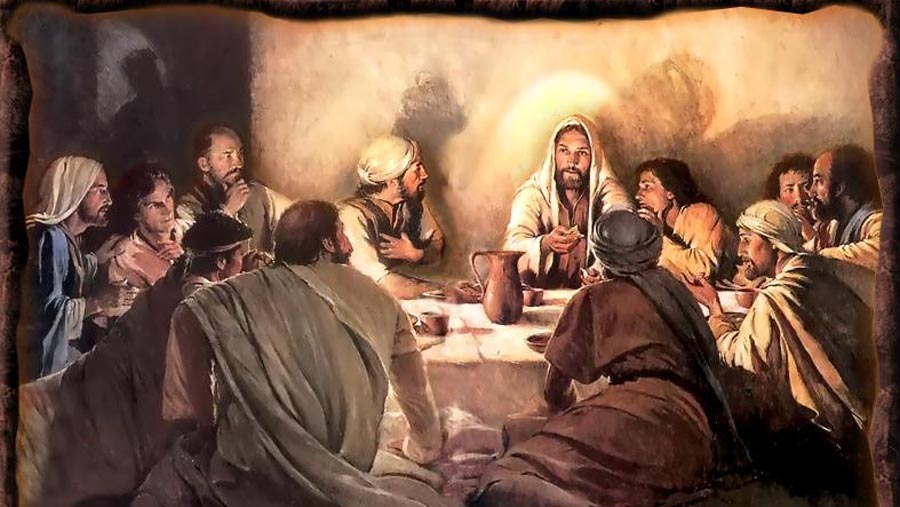
Think about the last time you badly wanted to listen in on a conversation. You may have been seated at one end of a table and craned your neck to hear the conversation at the other end. Or maybe you’ve longed to be "a fly on the wall" to absorb a conversation in which you simply had no part. I’m not sure where your thoughts are right now, but consider this: What better conversation to eavesdrop on, but the conversation between our Savior and his disciples in the Upper Room?

Imagine being part of a Small Group/Care Ring led by Jesus himself! John’s Gospel stands alone as the only record of Christ’s words in the Upper Room. And John invites us to pull up a chair and listen in. Within hours of this gathering, Jesus was hanging upon a cross. In less than twenty-four hours he was dead and buried. These are indeed the last words of Jesus before his death on the cross.

Some scholars have called the conversation in the Upper Room the "holy of holies" of Scripture. That is, if you think of Scripture as a temple, this is the sanctuary, where you come into the very presence of God himself. Through his words to his disciples, we are permitted here to enter into the thinking, the emotions, the very heart of Jesus just hours before his own death. Jesus lays bare his heart before his disciples and He seeks to impart to them the secret of his life. The disciples will soon understand that this secret explains all of the marvelous words that Jesus spoke and each one of the miraculous works He performed. And this amazing truth is ours too.

Jesus distills for his disciples – and for us - the most important truths and spiritual principles of the Christian life. He talks about the Holy Spirit - another Comforter -- a Strengthener who is on the way. Jesus tells the disciples that he will no longer be merely with them but within them. This is powerful! It is this indwelling presence that enables – in fact makes possible -- living in our predominantly troubled world. Our Jesus does not so much discuss the world as he does how to deal with the world. So the message of the Upper Room is a vital message for each of us.

As we move toward the Easter Season here at Crane Chapel, we’re going to spend some time considering this small-group meting between Jesus and his disciples in John Chapters 13 – 17. Please come these next weeks with great expectations and an eager heart as we look into this deep and insightful passage. The Upper Room really is the quintessential Small-Group/Care Ring study. By listening in, we can each uncover the secrets of living a fulfilled life with Christ!


Pastor Mark and
Esthermay Bentley-Goossen

Thursday, March 02, 2006

Post Script on Suffering


It may be cancer or a sore throat. It may be the illness or death of someone close to you. It may be a personal failure or disappointment in your job or schoolwork. It may be a rumor that is circulating in your office or your church, damaging your reputation, bringing you grief and anxiety. It can be anything from a mosquito bite to facing a lion as Daniel did. It is suffering.

The Book of Job approaches suffering largely from one angle. Job’s suffering ultimately brought him to a high degree of spiritual refinement. His suffering was not so much punishment as it was disciplinary. But why do we suffer? Christians are subject to common calamities just like the rest of the world. If God protected His children from all storms, disappointments, poverty and destruction, they would be tempted to serve Him for selfish reasons, just as Satan falsely accused Job of doing. Good people have no insurance against physical death; even innocent children and babies die. In my studies, I’ve
uncovered the following from Scripture as reasons for our suffering:

  • Refines the Christian (Job 23:10)
  • Brings the fruit of righteousness
  • Discipline from God (Hebrews 12)
  • Caused by the reaping of sin (Gal. 6:5-6)
  • Cause by the sin of others (alcohol, temper, thieves, gossip, etc.)
  • Result of a bold witness for Christ (Phil. 1:29, I Pet. 4:12-13)
  • Prevent a wrong course of action (Ps. 119:71, 67)
  • Shows us our need of God (Ps.119:71)
  • Brings patience (James 1)
  • Prepares us for a future test (I Cor. 10:13)
  • Brings solitude/ Helps us hear God
  • Brings future rewards (James 1:12, II Tim. 2:12)
  • Caused by violation of God’s natural laws
  • Caused by violation of moral laws
  • Brought by Satan under Gods’ permissive will
  • For God’s glory (Ro. 8:28, Jn. 11:4)
  • Shows us God’s comfort, grace and power (II Cor. 1)
  • Teaches us how to comfort others (II Co. 1:4)
  • Unites Christians/ opportunities for saints to minister (Acts 12)
  • Helps us identify with Christ’s suffering and example (Phil. 3:10)
  • Teaches us obedience (Heb. 5:8)
  • Keeps us humble (II Co. 12:7-10)

Jesus explains, “The thief’s purpose is to steal and kill and destroy. My purpose is to give life in all its fullness” (John 10:10). None of us is immune to the thief (Leviathan) and none of us will escape suffering. But it is during times of suffering that we learn to refocus our lives on God. David confessed it in Psalm 119:71: “The suffering You sent was good for me, for it taught me to pay attention to Your principles.” If it still doesn’t make sense to you, just learn to rest in God’s sovereignty and trust in His Goodness and Love.
-Pastor Mark

Job's Epilogue...


The last Chapter of the Book of Job seems to hurriedly yet neatly tie up one of the most intellectually rich and challenging Books of the Bible. The verses are often ignored or quickly and easily identified as a simple fairy tale-like conclusion. What a mistake! We’d miss the whole point! This is a part of Scripture that we should not let go of until it has fully probed our thinking regarding God’s sovereignty, human suffering, and restoration.
What the closing narrative tells us is that Job is -- at long last -- through both Truth and humble trust -- fully transformed, fully vindicated, and fully restored with double his goods and wealth, blessings over and above what he had in Chapter 1, and a replacement set of children. And his life is more than doubled. Job lives another 140 years which is twice the biblical span of our days (Ps. 90:10).

Would the message of the Book be any different if God had not restored Job? No. God is still sovereign and the whole matter of suffering would still have been at the forefront of our study. It would have still been necessary to consider the questions of “Why vs. Who” and “Good vs. Evil.” The whole notion of human emotions, counseling the troubled, and comforting the hurting would still have been addressed. And we would still have had to put our personal trials in proper perspective alongside the enormity and grandeur of God’s creation.

Henry Morris, a renowned Christian scholar, has said that Biblical Creation is the answer to all human suffering. Do you suppose if you made an appointment with a psychotherapist for help with depression or anxiety, you’d hear that!? Hardly! But as we’ve learned through our study, it is only through our understanding and a profound appreciation of God’s creation and sovereignty that we can put our suffering into perspective and be emotionally and spiritually restored.

On the flip side, the brevity of the conclusion of Job’s story invites questions and even speculation. The Book of Job is unique in that it emphasizes that an inheritance is divided among daughters (as well as sons). Job 42:14 lists the names of Job’s three daughters -- but not the sons. Does Job now question “tradition” and act accordingly in paying tribute to daughters? Does he now see that the security of earthly possessions is irrelevant? What is Job’s spiritual condition as the story wraps up in the closing verses? Does he pray? Does he have joy? Does he continue to worship God? Are these questions even relevant? Yes, questions still ring in our ears. And in my mind, the only remedy for that condition is to read the Book again! And again….


- Pastor Mark

Thursday, February 16, 2006

Rocks of Adversity...


From the beginning verses of our study, Job has longed for an opportunity to plead his innocence before God. Finally God appears in Chapter 38 and gives Job that opportunity. And what does Job do? He remains silent. It had become clear to Job that it was no longer necessary for him to speak. In his first address, God challenges Job with the magnitude and grandeur of His natural creation. From the stars to the ocean to the desert, what does Job know about anything? Job is humbled and ashamed and he concedes his unworthiness. But God is not done….

God moves now beyond the creation and supervision of the elements to the animal kingdom and his care for it in order to further demonstrate how limited Job’s knowledge really is. God has filled the earth with living creatures that are absolutely dependent upon Him for life and for the sustenance of life. God’s zoology lesson was not intended to end with a quiz, but to allow Job to become fully aware that the God who cares for every creature on the earth would most certainly make adequate provision for the one He had created in His own image!

God’s zoology lesson begins and ends with lectures on animals of prey – the animals that in today’s world are considered injurious and of no value. Yet, God cares for them with unerring wisdom. (Do you consider some things in life valueless? God doesn’t.) He speaks of the mountain goat that inhabits the most inaccessible and rugged mountain areas of the earth. Job could hardly miss the point here. Was Job himself not climbing over rugged rocks of adversity? God continues. . . He speaks of the life cycle of the animals -- the moment of birth and the moment of death. Something - again - that God knows and we do not. God moves on to the ostrich – a most unusual and brainless bird as it is devoid of any maternal instincts at all! (Know anyone that fits that description?”) A mistake on God’s part? Hardly! God provides for the young eggs’ protection in the most amazing way and provides food for the young bird in the very eggshell from which it hatches. Chance? No. Proof again of the wisdom of God in caring for his creation. The examples and lessons go on and on. And on. . . . As anyone who has studied the animal kingdom knows, God’s creation is truly vast and incredible and inexplicable.

God had shown Job once again that as a limited human being, he has neither the ability to judge the God who created the universe nor the right to ask the why of anything. God’s actions do not depend on our lack of understanding. God’s challenge to us then, is first to be awed by the natural creation and our insignificance within it, and secondly to realize the magnitude of the task he has in bringing both righteousness and judgment on both his creation and those created in His own image. It is ours to question the rocks of adversity in any way at all? Are you getting the point?


- Pastor Mark

Monday, February 13, 2006

GOD Speaks...


By the time we reach Chapter 38 in the Book of Job, we’ve come to appreciate the depth of Job’s affliction, we’ve wallowed in his misery, we’ve undeniably considered our own suffering, we’ve listened to Job's smart-aleck friends offer their own pretentious and useless wisdom, and we’ve perhaps ourselves questioned God’s role in the whole mess. At this point we are left pretty much famished for spiritual food and drink. Enter: GOD. Not through another “counselor,” but by direct revelation!

God speaks for 70 verses in these next two chapters before Job has an opportunity to respond. And when he does, Job only mumbles words suggesting that God’s speech has undone him (Job 40:3-5). What is it in the words of Job 38-39 that evoke such a change from the defiant Job of 31:35 to the abashed Job of 40:3? Speaking from a whirlwind of a mighty storm, God – surprisingly – does not answer any of Job’s questions. Instead of answering Job’s charge of abandonment, God challenges Job to respond as He defends the design of His creation and the very existence of the entire universe. As we read these poetic verses, it is obvious that God’s questions could not possibly be answered by any human. The Divine questions reveal to Job that he does not know the ways of God. And if Job is ignorant of the earth’s natural order, it’s ridiculous to think that he (or any human) could comprehend the moral order of God. There is a purpose in creation that God knows but Job does not. There is a purpose in human suffering that God knows but Job does not. God's great power and wisdom is certainly a contrast to Job's limited ability and understanding. Overwhelmed, Job admits his unworthiness and inability to answer. But, God is not through with Job yet. God continues for 53 more verses! You could say Job was silenced and humiliated by his own self-centeredness and pity.

Henry M. Morris writes these words


. . . even Christians have become self-centered instead of God-centered. We emphasize personal Christianity, personal experience, self-image, inter-personal relationships, and what Jesus can do to meet our needs. All these have their place in the Christian life, but not when they relegate God and his purpose in creation to only a peripheral role ….


(The Remarkable Record of Job,©1988)


So why is the issue of suffering never directly settled by God? Why does God focus exclusively on His creation and His providential care over it? The entire Book of Job presents a story that moves beyond what it means for humans to suffer. It should lead us to inquire what it means to be an ordinary human at all when God is truly GOD. And if he is GOD, there is little else to do but to submit our suffering to Him and rest in his care.

-Pastor Mark

Friday, February 03, 2006

Weep With Those Who Weep...


Counseling is an often-used word today, but what do we really understand of it from a Biblical perspective? The Book of Job is replete with lessons on suffering, but one of the greatest that we can apply to the church body is that of how to counsel and how not to counsel those who are hurting? Counseling can do harm. Job evidently took some time to recover from his friends’ “counseling.” Recovery only came after Job forgave and prayed for his counselors. (Job 42:10)

Let’s revisit Job’s counselors: They wept. They mourned. They sat with Job in the dirt, in shocked grief, speechless, for seven long days. Great start! They might have done well to just pack up their stuff and leave at this point. But, like so many of us, they became impatient and instead of filling their divinely appointed role of comforter, they chose the world’s preferred alternative of claiming godlike knowledge. They focused their efforts on becoming superior-advice-giving-therapists, rather than comforting and counseling their friend as a peer.

When they saw him…they began to weep aloud …they sat on the ground with him for seven days and seven nights. No one said a word to him, because they saw how great his suffering was.


- Job 2:12-13


Like Job’s friends, we also tire of being in the dirt with our hurting, depressed, and often-irritable sisters and brothers. We want to dust ourselves off and show that we’re above that sort of thing. We refer our hurting friends to secular therapists and best-seller books. We rely less on God and our divinely appointed role as comforters and defer to a therapeutic culture, that looks beneath every hurt, pain and struggle in life and finds a psychological disorder that needs repair; and more often than not: a pill. What’s really going on is a soul crying out for what only Jesus Christ can provide. We need to quit relying on professionals to fix damaged “psyches.”

The problem is disconnected human souls. The church is designed to “grow and build itself up in love, as each part does its work.” (Ephesians 4:16) Just as spiritual gifts are to be used for the entire church body – so is its capacity to listen, understand, empathize, and nourish. If you’ve ever received comfort from God – no matter how small - you have something in you that could deeply impact someone else who is hurting.


…. the God of all comfort, who comforts us in all our troubles, so that we can comfort those in any trouble with the comfort we ourselves have received from God.

- II Corinthians 1:4

You can stimulate the lonely, revitalize the discouraged and introduce hope into the lives of people who feel rejected and useless. Even if you yourself feel rejected and useless. Look at Jesus for inspiration. He is – after all - the Wonderful Counselor. (Isaiah 9:6) He was the Son of the God of the Universe! Yet he was humiliated his entire life. He was despised and rejected. (Isaiah 53:3) He was physically vulnerable, weak, tempted, subject to pain, and as the final disgrace, rejected by God. (Matt. 27:46) We see him tired, thirsty, in tears, impoverished, ridiculed. Scripture stresses that the thing that equipped Jesus for his ministry was that he became like those he was called to help. Today, we’ve somehow established that only those exalted to godlike status holding PhD’s are empowered to minister and counsel. Nothing could be further from the truth. Even, the most renowned Christian counselors have said that they are only able to truly help people when they put aside their academic training and rely upon the Lord to direct them. And isn’t this what each of us is called to do?

Much heartache could be averted in the body of Christ if we could learn to “weep with those who weep.” (Romans 12:15) Not necessarily shed liquid tears, but unashamedly embrace the pain of others, and let it be obvious that “if one part of the body suffers, every part suffers with it.” (I Cor.12:26) It’s a huge shift in thinking, but the greatest need for the hurting and depressed in our community is not to have more counseling centers or psychotherapists, but a church body where Christ is exalted and ordinary people learn to shepherd the hurting because, Biblically speaking, simply being a friend, confidant, and sympathizer, is a lofty role that not even angels or God himself can fully fill. Only we, for instance, can give a hug or share coffee with a friend. People in pain need to know that they are not alone - they need people with whom they can relate. They don’t need advice as much as they need company and comfort. We don’t see Jesus asking his disciples for advice, but we often see Him asking for their company. Advice is cheap. Comfort is precious.
-Pastor Mark and Esthermay Bentley-Goossen

Thursday, February 02, 2006

Elihu To The Rescue


Anger and youth are not qualities valued in the wisdom traditions of the Old Testament. But in Job Chapter 32, we’re introduced to Elihu as an angry youth, frustrated with Job and his three friends and Elihu might just have the answers for which Job is desperately searching. Was God at last using someone to speak truth to Job? Elihu is presented as a “Buzite” and this lineage is important to his character. The Hebrew noun “buz” means contemptuous or contemptible and occurs several times in the Book of Job (Job 12:5, 21 and 31:34) with the same meaning. Is the author trying to tell us that Elihu is a little bit out of control? We have to wonder what kind of “counselor” this new kid is going to be.

Eliphaz, Bildad and Zophar were lousy counselors who repeatedly brought accusations against Job trying to convince the poor guy that he was suffering because of his past sins. They were of no consolation at all! Now here’s Elihu: He does speak very clear, plain words, but his attitude is a bit obnoxious. He assuredly maintains that Job’s suffering will leave when Job realizes his present sin. He maintains that Job wasn’t suffering because of sin, but was sinning because of suffering. While Elihu’s speech was on a much higher plateau that the others, he still wrongly assumed that a correct response to suffering always brings healing and restoration and that suffering is always in some way connected to sin. The new kid did bring Job to an awareness that he ought not exalt himself so piously, but imagine how you’d feel – having gone through all that Job had -- being put in your place by a smug, overbearing teenager!

So what can we learn from Elihu? Correctly, Elihu exhorts that suffering is not meant to punish us as much as it is meant to correct and restore. And the bulk of Elihu’s counsel focuses on the justice of God, which Job has repeatedly criticized. He concludes his session with an effort to speak on God’s behalf …. He admonishes Job to sit still and consider the wondrous work of God. Elihu seems to be preparing Job for what is about to follow.

To be continued. . .
- Pastor Mark