Thursday, August 03, 2006

Prejudice & The Great Commission

Any doubts the disciples had during Jesus’ ministry of His concern for all people, should have been erased at His ascension when He gave the apostles and the Church their mission statement: “Therefore go and make disciples of all nations” (Matthew 28:19). But in very much the same way that prejudice separates people today, discrimination ran so deep in the early Church that conversion to the traditions of Judaism was almost a prerequisite for coming to Christ. So basically, up to this point in our study, the Church was an offshoot of Judaism.

The story of Cornelius changed that. But only through God’s direct intervention! The walls between Jews and Gentiles were just too rigid and formidable. Cornelius, a Gentile, is identified as a Centurion in the Italian Regiment and we’re told that he is devout and God-fearing. So it makes sense that God was working in his life and preparing him: It began on a certain day about three o’clock in the afternoon, which was a time of prayer for Cornelius. But on this particular day, he had a vision. An angel came to him and said, "Your prayers and gifts to the poor have come up as a memorial offering before God" (Acts 10:4). The angel was speaking in the language of sacrifice used in Jewish circles and the message was that God was pleased with Cornelius, and was ready to reveal Salvation to him. In preparation for this, Cornelius was instructed to send for Peter. And so he did.

Now while Cornelius was eagerly anticipating this meeting, Peter was a most reluctant evangelist. It took a direct edict from Heaven to lead Peter to change his view on Gentiles. Remember: Peter is a man with deep and abiding convictions, whether in the will of God or floundering against it. (This is the guy who jumped out of the boat after Jesus … then denied him three times!) …And so it was indeed in a dream that God prepared Peter: A dream about – of all things! – clean and unclean animals inside a large sheet held up by its four corners and being let down to the ground. And so after arriving at Cornelius’ home, Peter acknowledged that his coming was only at the Lord’s leading for God’s purpose: “God has shown me that I should not call any man impure or unclean” (Acts 10:28). After Cornelius shared with Peter the events of his angelic visit, Peter knew God sent him there for one purpose, to extend the gospel to Cornelius and all the other Gentiles present.
As we study this account today more than 2,000 years later, I hope we learn a valuable lesson from it. The story of Cornelius and Peter leaves no doubt of the Lord’s intent for the Church: The Gospel is for EVERYONE! The clash of Jews and Gentiles is not unlike the clashes of prejudice today. We must seize our opportunities to clearly convey the message of Jesus with whomever – whenever – and wherever we are given the opportunity. We cannot allow prejudice to obstruct the clear purpose of The Great Commission!

- Pastor Mark

Friday, July 28, 2006

Blinded But Enlightened ... and Transformed!

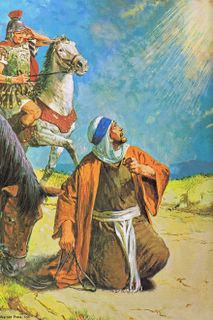
…Suddenly a light from heaven flashed around him. He fell to the
ground and heard a voice say to him “Saul, Saul, why do
you persecute me?” “Who are you Lord?” Saul asked.
“I am Jesus, whom you are persecuting….”
Acts 9:4-5

The account of Saul’s conversion is dramatic and intense. It’s not a story that too many of us can entirely relate to since it’s doubtful that any of us have been knocked to the ground by a flash of light and a voice from heaven. But how many of us began as a vicious persecutor of Christians? Even so, Saul’s experience on the Damascus Road can teach us some very important lessons about the nature of transformation.

I’ve often heard people say about their conversion something like this: “I found Christ under such and such circumstances,” or “I came to faith in such and such circumstances.” That’s backwards! Sure we have free will to accept Christ, but it’s not too often that the needy, angry, self-destructive person is seeking to find Jesus. In the same way that Jesus found Saul in his circumstances, Jesus finds us in our circumstances. Jesus seeks us and gives himself to us. He did it when He died on the cross. … Let’s look at what happened next:

Saul got up from the ground, but when he opened his eyes he could see nothing. So they led him by the hand… (Acts 9:8) The flash of light from heaven was so bright that it physically blinded Saul. Luke tells us that the men traveling with Saul stood speechless. They heard sound, but did not see anyone. Remember, it was Saul who was being sought by Jesus here -- not his traveling companions! -- and (here’s the tender part): That light was so bright that it penetrated the darkness of Saul's heart and filled him with the revelation that Jesus was indeed the Messiah. Paul wrote about this light from heaven years later:

For God who said, "Let light shine out of darkness,” made
His light shine in our hearts to give us the light of the knowledge
of the glory of God in the face of Christ.
(II Corinthians 4:6)

Saul's story really is the story of every one of us before we come to Christ. We are born as enemies of God, blinded by unbelief. We are born as grandchildren of Adam, depraved and lost. Some of us have pasts we are ashamed of (like Saul?)…. We were born into the world needing to be transformed!

Think about the words of John 3:16. Now think about Saul; and think about your own life. If you’ve already come to Christ and been transformed, your heart is filled with joy and thanksgiving. If you’re still resisting Jesus and looking for transformation through psychology or education or positive thinking, know this: Just like Saul – true transformation comes from a personal encounter with Jesus! Saul did not see a vision. He saw the Risen Christ Himself !
- Pastor Mark

Why Build a Church? ...Why Go to Church?

"The grass withereth, the flower fadeth:
but the Word of our God shall stand forever."
Isaiah 40:8
Eighteen years ago George Barna wrote a book entitled Marketing the Church. In the book he wrote, “The audience, not the message is sovereign.” It’s a notion that thousands of pastors and churches have unwittingly swallowed as if it were Scripture. It has been parroted in virtually every major book on church leadership since; and it’s being taught in seminaries across the country. The basic idea is that people’s“needs” must shape the pastor’s message. Opinion polls and listener response become barometers that tell a pastor what to preach.

Now compare that with the words of the Apostle Paul, who said (in II Timothy 4:2-5), “The time will come when they will not endure sound doctrine, but according to their own desires, because they have itching ears, they will heap up for themselves teachers; and they will turn their ears away from the truth, and be turned to fables.” Do you think Paul would have agreed with Barna, who said we must adapt our message to the preferences of the audience at the risk of having them reject the message?
Absolutely Not! Paul told Timothy: “Preach the Word! …in season and out of season. Convince, rebuke, exhort, with all longsuffering and teaching.” As your pastor, this is what I am called to do – not to follow the fads and fashions of our culture. Not even the evangelical fads that have assaulted the church in wave after wave over the last two decades. You know what I’m talking about: “What Would Jesus Do?” Bracelets, “Prayer of Jabez” stuff, Purpose-Driven merchandise (complete with the authorized trademark symbol.) Remember the “Toronto Blessing?” What about “Promise Keepers?” and all the Left Behind Books?

Why do I call them fads? Because that’s precisely what they are. They weren’t around thirty-five years ago, and they’ll be gone in ten. Why have Christians become so susceptible? Why are evangelicals so keen to jump on every bandwagon? In a word: simplicity. The fads water-down the Word of God: Scripture is more often than not out of context. The message is soft and generic and non-threatening so it doesn’t rebuke anyone’s sin; endanger anyone’s shallowness; threaten anyone’s comfort zone; or challenge anyone’s worldliness. The fads hardly ever take a stand on the controversial issues. God’s Word is unmistakably clear on today’s controversial issues!

I’m convinced that those who do not get back to the business of preaching the Bible will soon see their churches die – because the Word of God is the only message that has the power to give life!

Now. . . as the shepherd of a congregation in the midst of constructing a new church building, I’d be inconsistent – even remiss – if I didn’t challenge Crane Chapel to remember what the Church is all about! We’ve been working our way through the Book of Acts – the Building the Church Series - and I hope you’ve been listening. We definitely live in an entertainment hungry world with an increasingly entertainment hungry church. Christians today are having a harder time facing the serious stuff of life because they aren’t hearing the serious stuff of Scripture. Faith does still come by hearing, and hearing the Word of God! Why are we building a church? To preach the Word!!

Now. . . Why are you coming to church?

- Pastor Mark Goossen
"Heaven and earth shall pass away:
but my words shall not pass away."
Mark 13:31

Sensitive Hearts, Total Strangers & Revival

There is a remarkable account in the Book of Acts where a man named Philip witnesses to a total stranger from another country and graciously guides the man to faith in Jesus! The story is set in Samaria and begins with what our culture would call revival.

There was great enthusiasm among the believers. Christians were proclaiming Christ from village to village. The mood was enthusiastic and contagious. Acts 8:25 brings us into the scene: And so, when they had solemnly testified and spoken the Word of the Lord, they started back to Jerusalem, and were preaching the Gospel to many villages of the Samaritans.
Suddenly God steps in and does something completely unexpected and out-of-the-blue. He sends an angel to redirect this man named Philip: But an angel of the Lord spoke to Philip saying, “Arise and go south to the road that descends from Jerusalem to Gaza.” And he arose and went…. (Acts 8:26-27)

Now…without thinking in terms of a dictionary, define revival. Are you thinking in terms of thrilling and exciting or are you thinking more along the lines of sensitivity and quite anticipation? Revival is both. But without the sensitivity to and anticipation of God’s direction, how would we know what His direction is!? His work would never be accomplished!

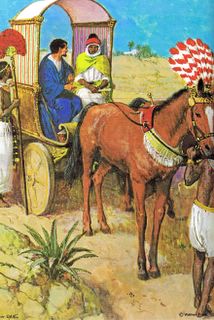
When we’re sensitive to God’s directing it naturally follows that we will be available for whatever He calls us to do. So what did Philip do? …he arose and went. Look what happened next: …and behold, there was an Ethiopian eunuch, a court official of Candace, queen of the Ethiopians, who was in charge of all her treasure…. He was sitting in his chariot reading the prophet Isaiah. And the Spirit said to Philip “Go and join this chariot.”

What a choice opportunity! Imagine being directed by an angel to a desert road – away from the rousing environment of a revival where you just happen to encounter a political leader from another country! The Secretary of the Treasury no less! And he’s reading Scripture! Now in today’s world, if you were to encounter someone reading their Bible, what would you do? Would you reflect quietly, “That person’s a Christian. That’s very special,” and continue on your way? Or would you sit down and initiate a conversation? Sadly, I think most of us would opt to continue on our way.

Philip opted instead to talk to the stranger. And Philip initiated the conversation. And the eunuch answered Philip and said “Please tell me, of whom does the prophet say this?” (Talk about an open door for witnessing!!) The government official had confessed his ignorance and he warmly accepted any teaching Philip could offer so Philip opened his mouth and beginning from this Scripture he preached Jesus unto him. (Acts 8:35)

Wow! When was the last time you witnessed to a complete stranger? When was the last time you were sensitive enough to hear and discern God’s direction to witness at all!? We do live in a superficial and fast-paced society. And we tend to think of revival in terms of old-fashion tent meetings and people on their knees pleading with God to do something. Here’s an assignment for you: Pray that you might be sensitive to at least one opportunity to witness and share Jesus this week. Revival begins with anticipation and a sensitive heart.
– Pastor Mark

Stephen: His Miracles, His Message, His Martydom

We are first introduced to Stephen when the apostles informed the Church that is was not right that they neglect the Word of God in order to wait tables. Stephen was chosen as one of the seven to take up the work of serving the widows. He is described as a man who was both “full of the Spirit and wisdom” (vs. 3) and as one who was “full of faith...” (vs. 5). Stephen’s new ministry seems to have put him in contact with a great many people. And the mention of Stephen’s ability to perform “wonders and miracles (vs. 8) is very significant. It seems to imply that Stephen was, or at least functioned similarly to, an apostle. God had indeed purposed to make this man an apostle, in His own time, and in His own way. And – just like Peter – Stephen’s ministry incensed the Sanhedrin. So we find Stephen – just like Peter -- defending himself.

But Stephen’s defense before the Sanhedrin is really more of a sermon. It is the longest recorded sermon the Book of Acts. And Stephen’s sermon is Scriptural. One cannot imagine how any more Scripture could have been packed into one message. Stephen is not like so many contemporary preachers who begin with a Scripture text never again to return to it. His entire message was Scripture! And his conclusion was but an application of these Scriptures to his accusers. In spite of the fact that Stephen’s sermon had a very strong message of God’s judgment, it was motivated by a loving and gracious spirit. Yet the message was too much to bear. Just as they had done before, the Sanhedrin rejected God’s spokesman and they would do away with Stephen in an effort to do away with the message of Jesus.

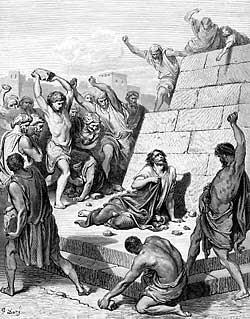
The description of the crowd is one of near insanity. They were out of their minds. Logic and reason would have agreed with Stephen, for his message was merely a recitation of the Old Testament. But the Spirit of Christ was present; and the crowd would have none of Him “and they stoned Stephen…” (Acts 7:59). They drug him out of the city and stoned him, with the consent and assistance of Saul. Stephen, like his Savior, called upon God to receive his sprit. His last words, like those of Jesus, were words of compassion. He prayed for the forgiveness of those who had sinned by taking his life. The salvation of Saul, while it would be at a later time, was an answer to this prayer.

What an illustration of dying grace! We hear much about being “Spirit filled,” but we don’t speak of it in the context of death. Stephen’s death, because it was experience by a Spirit-filled man, is a model for all Christians. And there are more direct applications of this text to us. Just as Jerusalem was rushing towards its own destruction, so is our own world. The judgment of God is soon to fall on our world for the same reason that it fell upon Jerusalem – rejection of God’s Word. And finally, there is the lesson in how to use and interpret Scripture. Stephen’s message was drenched in Scripture. There was much of God’s thoughts and none of Stephen’s. Stephen had a grasp of the Scriptures, as a whole, and in large potions. May we imitate Stephen in his handling of the Word of God!

-Pastor Mark

Thursday, July 13, 2006

Unity, Disunity, and the Church's Primary Purpose


The Grecian Jews among them complained against the Hebraic Jews… So the twelve gathered all the disciples together and said, “It would not be right for us to neglect the ministry of the Word of God.” – Acts 6:1-2

Proclaiming the word of God is the primary purpose of the church and Satan will do anything to distract God’s people from that purpose.

A few years ago I came across some small dark pellets in the area underneath our kitchen sink. With my brilliant mind I deduced that a mouse had been present in the kitchen! In the same way, whenever we see certain droppings in the church we must deduce that Satan is at work.

In this passage we learn that there were “droppings” of disunity, unhappiness, complaining and murmuring among the disciples in the early church. Why were these droppings there? Because Satan was at work. Satan is always opposing the church. Sometimes he brings opposition from without and sometimes from within. Here we see Satan working within the church by causing the people to murmur against each other.

Satan was trying to distract the apostles from their primary work of preaching the Word of God by calling their attention to the need for social service within the church, specifically in the area of food distribution. But the apostles would not be distracted from their calling. Why? They were called by Jesus himself to preach the gospel . Jesus told his disciples to seek first the kingdom of God and his righteousness, not the things of the world. Why? Man’s soul is infinitely more important than his body. What does it profit if a man gains the whole world yet loses his soul? The only way a sinner can be saved is through the proclamation of the gospel. So, when they heard the disciples murmuring, the apostles established a certain organization to deal with food distribution in an equitable way and “this proposal pleased the whole group.”(Acts 6:5) There is a need for a certain amount (and the right kind) of organization in the church. “God is not a God of disorder but of peace. Everything should be done in a fitting and orderly way.” (I Cor. 14:33,40)

Acts 6 speaks directly to the re-organization and re-appointment of deacons in the church so that its primary purpose is uninterrupted. Up to this point the apostles were just preaching the gospel and caring for the poor. But the growth of the early church created administrative problems. Satan tried to use these problems to destroy the church by inciting the disciples to murmur and complain against each other over - of all things - Christian service!
Today, we definitely live in a work-ethic society where people are measured and tend to measure themselves in terms of busyness and service. God has called each of us to Christian service (I Peter 4:10), but He calls us first of all to know Him. It’s out of that personal relationship that He then calls us to serve. We do not serve selfishly as an escape from loneliness, unhappiness, or some underlying, compulsive need – That kind of service is a “dropping” on the church body and it does not serve to proclaim the Gospel. Satan’s attacks and droppings are discouraging and disheartening. But they can also be an exciting challenge because we can only reach unity as a body and win victories when we’re fighting battles!

-Pastor Mark

Encounters With Civil Authorities

Then Peter and the other apostles answered and said,
“We ought to obey God rather than men.” - Acts 5:29


Peter and the apostles are in jail again being reprimanded by the Sanhedrin: “We gave you strict orders not to teach in Jesus name, didn’t we? Yet you have filled Jerusalem with your teaching and are determined to bring this man’s blood on us!” And of course, the apostles respond with civil disobedience by very straightforwardly announcing that they would obey God – not man!

The Sanhedrin neither liked nor did they welcome the apostles in Jerusalem because the reception of the Gospel by the multitudes was toppling their spiritual leadership. If the people had ignored the apostles’ preaching, the Sanhedrin would not have cared what the apostles did. But clearly the people were excited over the miracles and receptive to the message of Life in Jesus. Peter had become so popular among the people that the arresting officers were actually afraid to touch him. Now put yourself in Peter’s sandals and try to imagine a similar scenario today. Would civil disobedience be the “right thing to do?” What would you do?

Those who call themselves Christians today can harm the testimony of true Christianity by the way they behave toward civil authorities. Believers are to set their affections and priorities on Christ, and His Word, but they are also to be godly and obedient citizens in society. Sometimes it’s a fine line. Peter tells us (in I Peter 2:13) “Submit yourselves for the Lord’s sake to every human institution.” He was commanding believers to respect civil authority. And in I Timothy 2:1-3, Paul instructs us to pray “for all that are in authority; that we may lead a quiet and peaceable life.” Quite a contrast from Peter’s defiance toward the Sanhedrin. Where do you draw the line?

First, we need to acknowledge that God is in control of all situations and that He has ordained civil authority. (Romans13:1-7) So when a Christian submits to civil authority, he/she is obeying God. When civil authorities say, (for example) “We’re raising the Minnesota sale tax to 21.5% to fund highway maintenance,” and this does not violate the teaching of God’s Word, we should obey with meekness and without speaking evil of anyone. (Titus 3:1-3) It is sad when those who name Christ defy the very government He ordained. His Kingdom just does not benefit from disobedience. Even if we disagree!

The one exception is if civil authorities tell us to do something that would violate God’s Word. In Acts 4:18 the Sanhedrin commanded Peter and John “not to speak or teach at all in the name of Jesus.” We know that Jesus told us in Matthew 28:19-20 that we have authority to teach and make disciples of all men.” And we know what happened to Peter. As Christians we must stand for Christ and His Word and be willing to suffer the consequences. But we must be careful not to go beyond the teaching of God’s Word. The early church did submit itself to the extremely pagan Roman government, realizing that God had ordained it. What about you? Are you willingly submitting to our God ordained government?
– Pastor Mark
(21.5% sales tax?! See Romans 13:6-7.)

Encounters With Sadducees

Christians nowadays have it pretty easy. Not often will sharing the Gospel of Jesus send us to jail as it did Peter and John. Still we run risks in trying to win others to Christ. And while most of us might be willing to spend a night in jail if it would bring 5,000 people to Christ, shouldn’t we also be willing to suffer for the sake of one?

In Acts Chapter 4, Peter and John were sharing the Gospel of Jesus when – as scripture records – “The priests and the captain of the temple guard and the Sadducees came up to [them.]” What we need to understand about this group is that they were members of a powerful Jewish sect that did not believe in the resurrection of the dead. They stood to gain financially by cooperating with the Romans; and it was they who engineered and carried out Jesus’ arrest and crucifixion. The Sadducees had almost unlimited power over the temple and thus they were able to arrest Peter and John for no other reason than teaching something that contradicted their beliefs. And they did!

Now Peter and John stood before the same council that had condemned Jesus to death. Peter and John were questioned and this whole incident is considered the first persecution of the Church. But. . . instead of being defendants, the apostles were on the offensive: boldly speaking out for God and presenting the Gospel. In Acts 4:12 we find the final thrust of Peter’s defense speech. As Peter stood before these powerful, sophisticated, cultured, wealthy rulers of the Jewish people, the Holy Spirit gave him these words: "Salvation is found in no one else, for there is no other name under heaven given to men by which we must be saved."

Now, the Sadducees – along with many “Sadducees” of today -- reacted negatively to the fact that there is no other name than that of Jesus to call on for salvation. They say, "That’s too extreme. We believe in diversity and in accepting all “spiritual paths.” Surely Jesus isn’t going to send Indians, Chinese, Tibetans, and so on, to hell because they don’t believe in Jesus!"

Well, you may go ahead and call me a narrow-minded, extremist preacher! I will not apologize for preaching that there are only two paths: the broad way, which goes to hell, and the narrow way, which leads to eternal life with Jesus. You may accuse me of believing in this absolute truth that Jesus is the only Savior of the world. I do not mind because Peter’s statement is absolutely true: "There is no other name under heaven by which we must be saved." Peter did not decide this. The Church did not decide this. It is the specific teaching of Jesus himself (John 14:6).

As believers, we will encounter Sadducees. Perhaps you are a Sadducee – unwilling to accept that only Jesus saves. Be assured, Jesus alone saves! Not Jesus and Mary, nor Mary and the saints, nor our baptism as a child, nor “good works.” Whether we believe it or not, Jesus alone saves, and his purposes shall be accomplished! Are you willing to put yourself on the line for the gospel as did Peter and John? Are you willing to stand up to the Sadducees? Are you willing to stand up for Jesus when those around you start talking about “diversity” and accepting all “spiritual paths?”
- Pastor Mark

Thursday, June 15, 2006

The NFL, Barnabas & Father's Day


Joseph, a Levite from Cyprus, whom the apostles called Barnabas - which means Son of Encouragement – sold a field he owned and brought the money and put it at the apostles’ feet.”

- Acts 4:36


I
read about a University football coach who each year would privately talk to a new player at the beginning of football season. He told him, “I’m very impressed with your ability. If you work really hard this year, I think you’re good enough to make it to the National Football League.” He told this to every player on the team! You know what happened? He had the highest percentage of players of any University to make it into the NFL.

We’ve all met people like that who believed in us so much that we began to believe in ourselves. The result was we tried harder and we did better. The Book of Acts introduces us to an early disciple who was that way.

We first meet Barnabas in Acts 4:36. He was a Levite from the Island of Cyprus and apparently had some wealth. The disciples called him “Son of Encouragement.” And his name definitely matched his character.

After the Apostle Paul’s conversion on the Road to Damascus, Barnabas came along side Paul when no one else would. (Acts 9:26-27). Why? Barnabas was a very kind-hearted, gentle, and easy-going person. He had great compassion. And we will discover that Paul - unlike Barnabas - was a very stubborn man. Paul was used greatly by God but he was a very strong-willed man. Barnabas overlooked Paul’s rough character and they made an effective ministry team.

When the church in Antioch began to grow, Acts 11:22 tells us that Apostles is Jerusalem sent Barnabas there to help out the new church. Why? “He was a good man, full of the Holy Ghost and faith; and a great number of people were brought to the Lord.” (Acts 11:24)

In Acts 15:39 we read about Barnabas and a young minister named John Mark. Barnabas was willing to work patiently with John Mark when Paul - in harshness and haste - saw no hope for the young man. Do you see a pattern in the life of Barnabas?

We need more Barnabas’s in the church today. For that matter, we need more Barnabas-like fathers in the world: Fathers who are good and full of the Holy Ghost and faith. Fathers who will overlook character flaws and demonstrate compassion. Fathers who will see the potential in the younger generation and encourage it.
If you’re a father, you’re probably going to get an “interesting” gift today. Your children may do something that really makes you feel like a king. Soak it all it, because you deserve it and it’s good for your children to honor you. But honor them too by letting some of Barnabas rub off on you. Be a “Son of Encouragement.”

-Pastor Mark

Witness to a Miracle


One day at three o'clock in the afternoon, Peter and John were on their their way into the Temple for prayer meeting. At the same time, there was a man crippled from birth being carried up. Every day he was set down at the Temple gate, the one named Beautiful, to beg from those going into the Temple. When he saw Peter and John about to enter the Temple, he asked for a handout. Peter, with John at his side, looked him straight in the eye and said, "Look here." He looked up, expecting to get something from them. Peter said, "I don't have a nickel to my name, but what I do have, I give you: In the name of Jesus Christ of Nazareth, walk!" He grabbed him by the right hand and pulled him up. In an instant his feet and ankles became firm. He jumped to his feet and walked. The man went into the Temple with them, walking back and forth, dancing and praising God. Everybody there saw him walking around and praising God. They recognized him as the one who sat begging at the Temple's Gate Beautiful and rubbed their eyes, astonished, scarcely believing what they were seeing.


- Acts 3:1-10 (MSG)

Imagine now that you are in the above passage. It’s a Sunday morning and you’re making your way from your car toward the front doors of the Labor Center. You do a double take because you see Peter and John walking ahead of you. You’ve heard so much about them and now here they are coming to Crane Chapel! You wonder what they are talking about...what they look like in person…what kind of personality each has. You reach those double glass doors and you see a man who is disheveled and crippled – probably homeless - stretched out in that little alcove and he’s calling out to everyone passing by. Everyone knows about this guy. He’s a nuisance -always begging for money. You’re uncomfortable and embarrassed. The anticipation of what will happen next grabs your throat. You see the crippled man reach out to touch Peter and John! Others have walked by and acted as if the crippled guy was invisible. What next?!

It’s a clear beautiful warm day and the sun is shining as if spotlighting the whole thing: Peter and John stop and reach down tenderly to the man. Peter speaks to him and offers his hand. The man takes Peter’s hand and looks intently into Peter’s eyes. You feel a strong sense of the Holy Spirit here and you watch in awe – with everyone else around you – as the man gets up off the ground, stands with help from Peter, becomes tall and straight, and starts walking! You can’t believe your eyes! You’ve never seen anything like this before and in an instant you realize that Jesus– through Peter- has touched the man with healing and grace and mercy! You’re numb. You make your way into the building in silent wonderment and take a seat. And there’s the crippled “nuisance” guy beaming, joyful, and totally healed! What are you thinking?

Now, think about what those who witnessed the experience at Gate Beautiful in Acts Chapter 3 were thinking. This was actually the very first miracle of the new Church in Acts. We read in Chapter 4 that five thousand people were added to the Church. Do you think those witnesses just went home and thought about it? …Had they, would those five thousand have been added?

- Pastor Mark

Friday, June 02, 2006

They Devoted Themselves...


“They devoted themselves to the apostles’ teaching and to the fellowship, to the breaking of bread and to prayer.” - Acts 2:42


When you’re in the midst of a large project, every now and then you stand back and take a breath and look around. Sometimes in awe. If you missed the last few days at our building site you missed some awe. The foundation of Crane Chapel’s new church building is now standing - quickly erected over a period of just days! Milestones like this are good landing-places for us to consider again the mission of God’s Church.

In the Book of Acts, there are a number of such landing-places where Luke suspends the course of his narrative, in order to give us a general idea of the condition of the Church at the moment. Acts 2:42 is such a resting-place.

We’ve already seen how the early Church got its start with an encounter with the living God on the day of Pentecost. Luke records that thousands were brought to faith in Christ that day and were added to the Church. But their faith not only changed their destiny. It changed the way they lived!

What you believe affects what you do. This was certainly true of the first Christians. The text says that they devoted themselves. They devoted themselves first to the apostles’ teaching. In other words, they gave a high priority to understanding the Truth. Now that they had come to know Jesus, they wanted to know more about Him. They wanted to understand how to apply this teaching to their lives. Are you devoted to teaching?

The second thing they devoted themselves to was the fellowship. It is interesting how many people think that they really don’t need the fellowship of other believers. Not so for the early Church. They saw the need to continually devote themselves to a shared life with other believers. You can only experience true fellowship by giving diligent attention to meeting together with other believers. Are you devoted to fellowship?

Thirdly, they devoted themselves to the breaking of bread. Now this could mean one of two things – but probably both. It could mean that they shared their meals together. But it most likely meant that they devoted themselves to the ordinance of the Lord’s Supper. We observe this today.

Finally, Luke tells us that they devoted themselves to prayer. Their focus was heavenward, toward God Himself. They gave themselves to a life of prayer. … And so we see that God’s Church is a church in which people exhibit a deep level of commitment – a devotion to the disciplines of teaching, fellowship, breaking bread, and prayer. Let’s remember that. Our new building is only a physical structure – a place where we meet to express, share, and affirm our commitment to Christ.

– Pastor Mark

Thursday, June 01, 2006

Building Foundations


The first and foremost part of any building project, after receiving the blueprint, is the layout and installation of the foundation. All the tools and equipment and manpower are of no use until the foundation work is properly laid. And regardless of the efforts put into the construction of the foundation, the integrity of the foundation will be adversely affected by improper soil conditions. Those involved in Crane Chapel’s building project are very aware of these details. Bottom line: buildings need a well-thought-out, firm foundation and even the dirt has to be in good condition.

But let’s step back from Crane Chapel’s building project and consider another type of foundation. June is traditionally a month of weddings and wedding anniversaries and it’s a good time to reflect on the foundation of marriage. Much like the foundation for a building, marriage is the supporting building block of … well, human civilization! Read Genesis Chapter Two. After He created the universe, the first thing God instituted was marriage! God’s entire plan for human relationships begins with marriage. When we dismiss God’s plan for marriage, we undermine it altogether and society suffers.

Tragically, this is exactly what has happened over the last few decades. For the first time in its history, Western civilization is confronted with the need to define the meaning of the terms “marriage” and “family.” The loss of a true biblical understanding of marriage and family has led to a complete breakdown of the institution -- even among Christians.

Marriage is now easily severed by divorce. And even within traditional Christian marriages, couples refuse to acknowledge and accept their God-ordained roles and responsibilities. When marriage fails, the whole family falls apart; when the family fails, the whole society suffers. And every day the headlines are filled with society’s suffering. It may seem like an oversimplification of things, but the breakdown of marriage is a huge part of what’s going wrong in our world today.

So what kind of foundation makes a marriage work? In a word: God. God is the architect. He designed the blueprint for marriage and His Word addresses an entire spectrum of issues related to marriage and family. Issues from gender roles to human sexuality, reproduction, parenthood, and more. God’s design is that marriages are characterized by companionship, support, love, affection, full communication, understanding and mutual respect. Husbands and wives must fully realize that marriage is a life-long commitment regardless of wealth or poverty, health or sickness, or “irreconcilable differences.” Scripturally speaking there is only one (yes, one!) valid reason for divorce. So there’s the foundation: God’s Word.

Sadly, too many marriages have gone ahead and built on flawed foundations. They’ve ignored God’s blueprint or they’ve compromised it by selecting only the sections they like. And for a while (and in some cases many years) these marriages are maintained and they appear healthy. But over time, evidence of foundation failure manifests itself. The exterior structure deteriorates and a lot of time and effort are spent cosmetically repairing things rather than correcting the foundation. And what about the soil? (Crane Chapel’s building project was actually delayed because our soil samples exposed bad dirt!) What’s the condition of each spouse’s personal relationship with God? That’s the soil test of marriage! That’s where you have to start.

Ecclesiastes 4:12 says, “A cord of three stands is not quickly broken.” The rope-makes of the ancient world discovered that a rope made of a single or even a double stand of thread could be broken very easily; however, a rope made of thee stands was not so easily broken. The verse is not so much about ropes as it is about marriage. A person by him or herself, without companionship, support and love is like a cord of one stand. They are not very strong. Two people who support and love each other, like a rope of two stands, is stronger. A three-stand cord, however, is even stronger. In marriage a thee-stand cord is husband and wife and God. This sort of marriage is not easily broken.

There is no way to build a solid marriage without God. There is no way to sustain a marriage outside of His instructions. And while a solid marriage is built more quickly when both husband and wife accept and practice a Scriptural foundation for marriage, God expects each of us to respond to him regardless of the circumstances of our family. When only one spouse is committed to God, the union can still be blessed! The best part is that God allows and encourages us to turn from our past and begin following Him today.

How many cords are there in your marriage? What’s the condition of your foundation? How about the soil?

- Pastor Mark Goossen

Friday, May 26, 2006

The Birth of the Church


“For John truly baptized with water;
but ye shall be baptized with the Holy Ghost…”
- Acts 1:5

What thoughts come to mind when you hear the phrase “Baptism of the Holy Spirit?” How about the word “Pentecost?” A lot of Christians get nervous when the topic is addressed. The whole issue of “speaking in tongues” is raised and it scares people. The uneasiness is most likely born out of a misunderstanding of the actual events in Acts Chapter Two. In actuality, the passage very plainly and quite straightforwardly narrates the Birth of the Church.

(By the way, Pentecost is simply the Greek name for the Jewish Festival known as “Feast of Weeks.” Translated, the word means “fiftieth” and the festival came exactly fifty days after Jesus’ resurrection. And we’ll get to the “tongues” part…)

Acts Chapter Two is one of the greatest transitions recorded in Scripture. Up to now, the Spirit was with God's people, but from now on, He would indwell them and then fill them. In Chapter One, Jesus prepares the way for the birth of the church, and in Chapter Two it's born! In Chapter One, the disciples wait for the Holy Spirit, and in Chapter Two He comes! In Chapter One they are equipped by Christ, and in Chapter Two they are empowered by the Spirit. Basically, Chapter Two satisfies Chapter One. Acts 1:8-9 says, "Ye shall receive power after the Holy Spirit is come…” And after He had spoken these things, He was taken up…. Christ’s presence was in a physical form during His ministry on earth. And when He left this earth, His presence – and ministry -- remained alive and visible by the indwelling and continual filling of His Spirit.

Acts Chapter Two records the first appearance of the Spirit which we know today as the indwelling. It was a one-time, permanent gift for all believers. But the Chapter also narrates a filling of the Spirit. It’s the filling of the Spirit that caused the disciples to run into the streets in joy. And it’s the filling that enables His work to be done in churches today. One commentator put it this way: “The pressure of His presence caused an eruption of joy! …The filling is thrilling. Anyone obsessed with the joy of Jesus is filled with the Spirit.” (C.S. Lovett)

As for the whole “tongues” issue – There were no “holy rollers” among the disciples at Pentecost. No. Nobody was praying quietly in a corner in some secret “prayer language.” No. The room was full of uncontainable excitement! Soon the noise was heard in the streets. People stopped to listen. And remember, Jerusalem was full of foreigners because of the Jewish Feast of Pentecost. It was then that the Spirit provided the gift of (known) languages and dialects to those filled with His Spirit. The Spirit had commenced His work - encouraging and facilitating the spreading of the Good News! Isn’t God’s wisdom and timing amazing! The Birth of the Church fell on a Jewish holiday and foreigners who had never heard of Jesus suddenly were hearing the Good News! . . . The Church really does work best and accomplish Christ’s purpose when it is filled with His Spirit.


- Pastor Mark

Friday, May 19, 2006

I Will Build My Church


The world’s view of the church today is anything but complimentary. Sure, Crane Community Chapel had some praiseworthy reports four weeks ago. Our groundbreaking ceremony was a top news-story on April 23rd. The event made each of the three local television stations and several regional newspapers and the stories were positive. But what about today? What words does the average non-churched person use to describe churchgoers? Here’s some I’ve heard (and remember, I used to work in a factory): hypocrites, religious fanatics, judgmental, out-of-touch, dull, lifeless, weird. The sad part is, most of these descriptions are true! Churches are guilty of these things. Why? Because many of us have forgotten what the Church really is!

Today, we begin a study of the Book of Acts. As we move through this study, we’re going to become eyewitnesses to the birth and growth of the Church – the way Jesus intended it. My hope is that we will recognize that the Church is not just a “body of believers,” but a body of believers with a very important mission.

The Book of Acts is the very essential sequel to Jesus’ ministry on earth. It’s very easy for us to think of the Resurrection Story as the END of His ministry. How wrong we’d be! Jesus’ life up to this point was just the foundation! I Corinthians 3:11 tells us that “…no man can lay a foundation other than the one which is laid, which is Jesus Christ.” Jesus could have elected to build His church some other way, but He chose instead to work THROUGH people. Specifically: His disciples. See, the work of the Church could not be done while Jesus was still in physical human form. The disciples were to operate in the flesh, while Jesus operated in the Spirit. The disciples were to effectively take His place on earth. And today – two thousand years later – it’s our job to take His place and carry on the building of His Church. We are going to understand through our study exactly what that means and exactly how we are to do it. And it has nothing to do with constructing a new building. A year from now, we will most likely worship in a brand new church facility. But our work as the Church will still be ongoing! The physical construction of a church building is short-lived. The mission of the Church is eternal!

Bible teacher Ray Stedman has called the Church the “secret government of the earth” because it “radically alters the status quo wherever it is found.” Interesting. The Apostle Paul says that the Church is “…the pillar and the ground of the truth.” (I Timothy 3:15) And Jesus said: “…upon this Rock I will build My Church; and the gates of hell shall not prevail against it.” (Mt. 16:18) Notice that Jesus’ words convey that the Church was to be built. His words are future tense. The Church had not yet been built. That was to be the disciples’ work. And today it is our mission. I’m afraid that it cannot be accomplished by a group of lifeless, hypocritical, out-of-touch religious fanatics. Let’s get busy understanding what the Church really is.


- Pastor Mark

Thursday, May 11, 2006

The Proverbs Woman vs. The Modern Woman


The demands on Mothers in today’s society are overwhelming! And there’s no doubt that a Mother’s Day message taken from Proverbs 31 presents an even more intimidating sense of duty! It’s safe to say that most mothers today are of two minds: There’s the old-fashion obligation to home and there’s the equally enticing responsibility to accommodate society’s idea of a “Modern Woman.” Is there something wrong with this? Unequivocally, Yes!

Most present-day Christian leaders would tend to agree that we now live in a post-Christian era. In other words, we are no longer a truly Christian nation due to the choices we have made as a nation over the last thirty years. This simply means that the influence that the Bible once had on our nation’s moral and social behavior has diminished to a level hardly recognizable. Have you noticed how everyone, regardless of their knowledge or expertise has an opinion about every aspect of life? And most of these opinions are formed completely apart from Scripture – especially the opinions on the role of a Mother.

Society today believes that it is completely free to set the rules and parameters for the family, for the home, for marriage, and for child development. By contrast, Christian Mothers need to see the family, home, marriage and parental responsibilities as framed within the parameters of God’s authority – the Bible!

Passages like Romans 12:2, “be not conformed…” are usually seen as applying primarily to morals, but not to things like mothering and child discipline. The thinking is, that for these issues we need the expert advise of social experts and psychologists. This is flat-out wrong! It creates the idea that there is both a sacred and worldly side to mothering and parenting. It enforces the idea that God’s Word is sufficient in the realm of religion, but lacking in other areas of life. For a godly woman, everything is sacred. All of our relationships – including being a mother – are to be directed by the Truth of Scripture.

The Book of Proverbs is a fairly good place to start. The entire Book can be seen as somewhat of a Parenting Manual. From its beginning to end, it holds wisdom…Wisdom meant to be passed on.

“She speaks with wisdom, and faithful instruction is on
her tongue… Her children arise and call her blessed;
her husband also, and he praises her….” Proverbs 31:26 28

- Pastor Mark

Wednesday, May 10, 2006

Come and See What God is Doing!


April 23, 2006 marks a new beginning for Crane Community Chapel. We broke more than just ground. We shoveled dirt, but we also welcomed the hard work that is to come – in both the physical and spiritual realm. We believe that God has great things in story for this church body as we continue to move forward under His guidance and His direction. Come and see what God is doing.

As we begin our own physical building project, it seems appropriate that we begin a study on God’s building program: The Church – the people and the disciples that make up the spiritual body. God’s building project is covered in the Book of Acts which records the birth of the Church in the First Century and it gives us a healthy blueprint for the building of our own church body.

The Book of Acts is a story of origins, told in retrospect, that shows how the earliest followers of Jesus came to understand who could belong to God’s Church and how they could belong to God’s Church. We will see how - despite tremendous obstacles - the Church moved forward. And we will see that these same principles can be part of our church today – they are timeless truths. The Book of Acts also shows us that nothing could keep the Good News about Jesus from spreading everywhere. That’s interesting. Isn’t that the mission of Crane Chapel?

Working together is a very important part of Christianity and it’s a very important piece of Crane Chapel’s history. Crane is a body of believers that has learned to work together. God has so many different jobs for us to do over the next months. We need to be open and willing to serve one another and with one another.

One of the most important things you can do as a person and as a church body is to make disciples. Discipleship is a biblical command that is not practiced in today’s world as much as it should be. Wouldn’t it be great if Crane Chapel started a new trend? See, when disciples are made, unbelievers are displaced and things in a community begin to change. Dramatically! People cannot serve two masters at the same time. You either serve Christ or something else. To be a disciple of Christ means that you study His words, see what He did, and then do what He said and did. This is the work of the Church: To expand His Church by being both an example and a disciple-maker in the community.

Back to that groundbreaking in April: Each person present that day felt the joy and the anticipation and the thrill of it. The beginning of construction is now reality and it’s a visible sign that Crane Chapel is moving ahead. It really does stir the emotion. Let’s channel that emotion now into the area of discipleship and the growth of God’s Church. We really did break more than just ground. We reaffirmed the mission of Crane Chapel.

Each of you has a gift or two or more. Each of you has a place not only in church, but also in history, an appointment by God. You are a piece of the Divine puzzle. You are part of God's plan and method. He wants you to be used, to be a part of His ministry to this community and the world. I am looking forward to sharing the timeless truths from the Book of Acts. Join me. And bring a friend!

-Pastor Mark Goossen

Tuesday, May 09, 2006


Shepard & Mommy

Selah & Mommy

September 17th

December 18th